

Why mid-market SaaS teams are consolidating in 2026
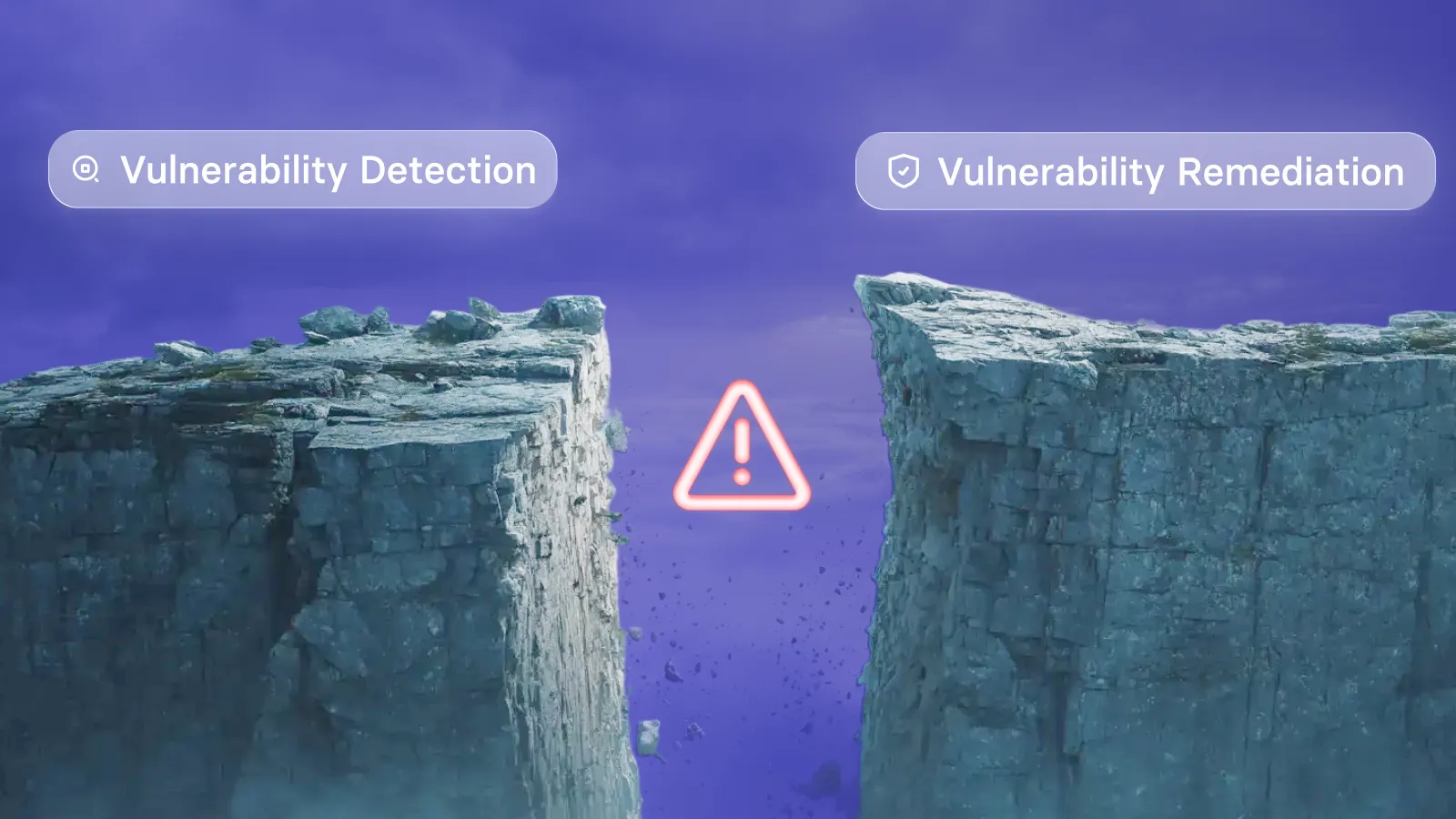
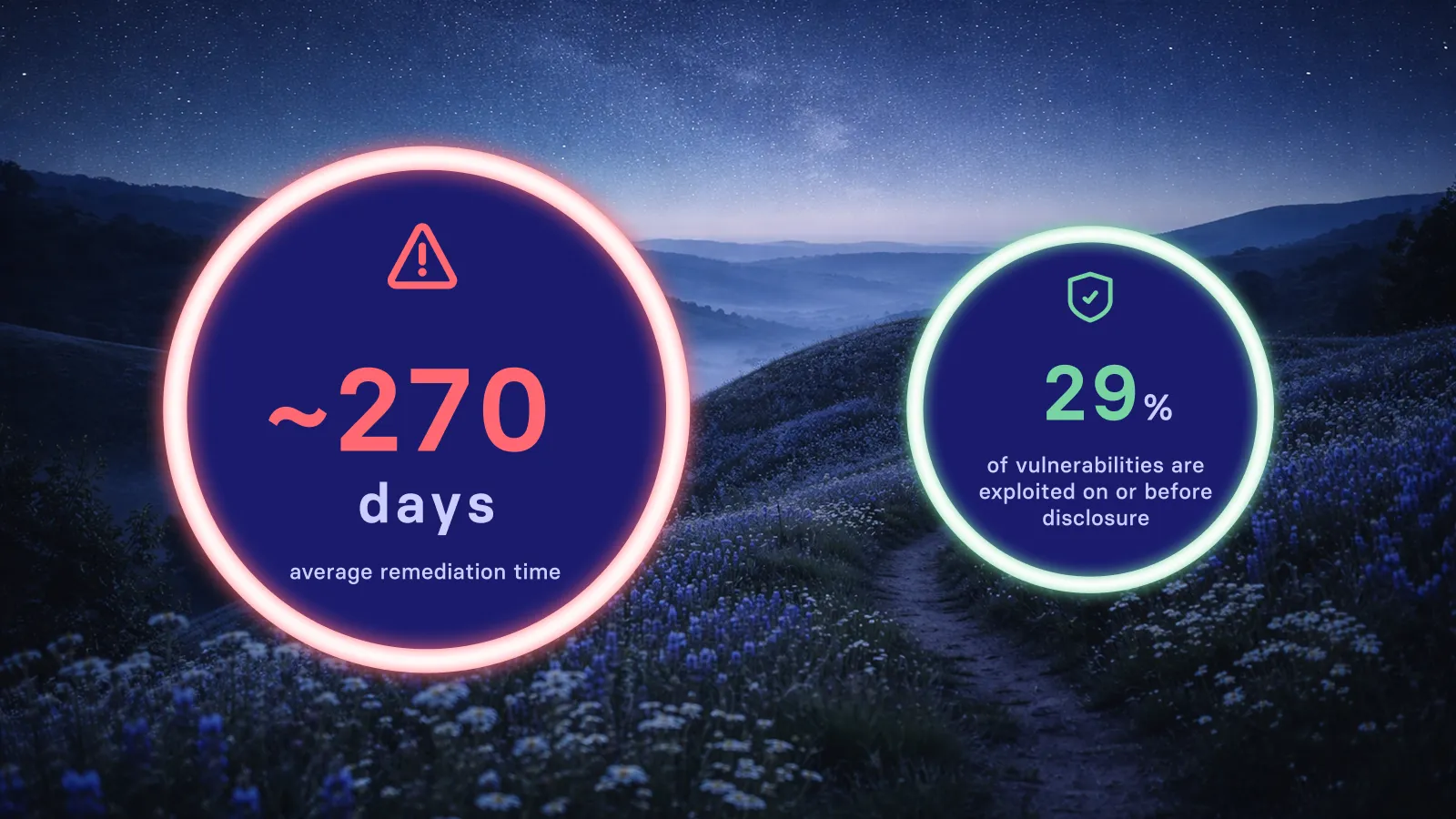
Mid-market SaaS security teams are not buying more tools this year. They are buying fewer. The Verizon 2025 Data Breach Investigations Report put median remediation time for edge device flaws at 32 days. CrowdStrike measured the average eCrime breakout time at 48 minutes. That math does not balance, and it will not balance with a separate scanner, a separate ticketing layer, and a separate patch tool stitched together by API.
Consolidation is the response. A consolidated vulnerability management platform pulls discovery, scoring, prioritization, remediation, and compliance reporting into one workflow. For a security team of three or four people supporting a few thousand endpoints across Windows, macOS, Linux, and SaaS, that consolidation is the difference between closing the loop and watching it stay open.
We scored ten platforms against the same five criteria, in the order mid-market buyers actually weigh them:
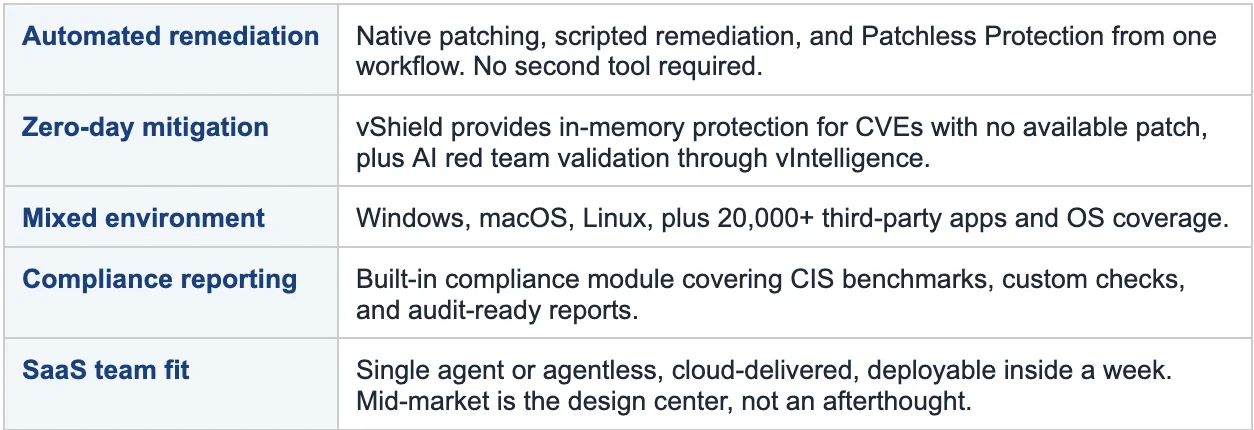
- Automated remediation. Can the platform fix the vulnerability without a second tool, and how much trust does the workflow earn before you flip the switch?
- Zero-day mitigation. When no patch exists, does the platform offer anything besides a CVE write-up and a wish?
- Mixed environment coverage. Windows, macOS, Linux, third-party apps, cloud workloads, and the long tail of vendor-specific software that runs your SaaS business.
- Compliance reporting. SOC 2, ISO 27001, PCI DSS, HIPAA, CIS benchmarks, and the audit packet your customer security questionnaires keep asking for.
- Fit for mid-market SaaS. Pricing model, deployment time, and whether a four-person team can actually run the thing.
No vendor wins every criterion. The vendors below are ordered by how well they answer the mid-market SaaS brief specifically: closing the loop from detection to validated fix, without hiring a SOC to operate it.
1. Vicarius vRx
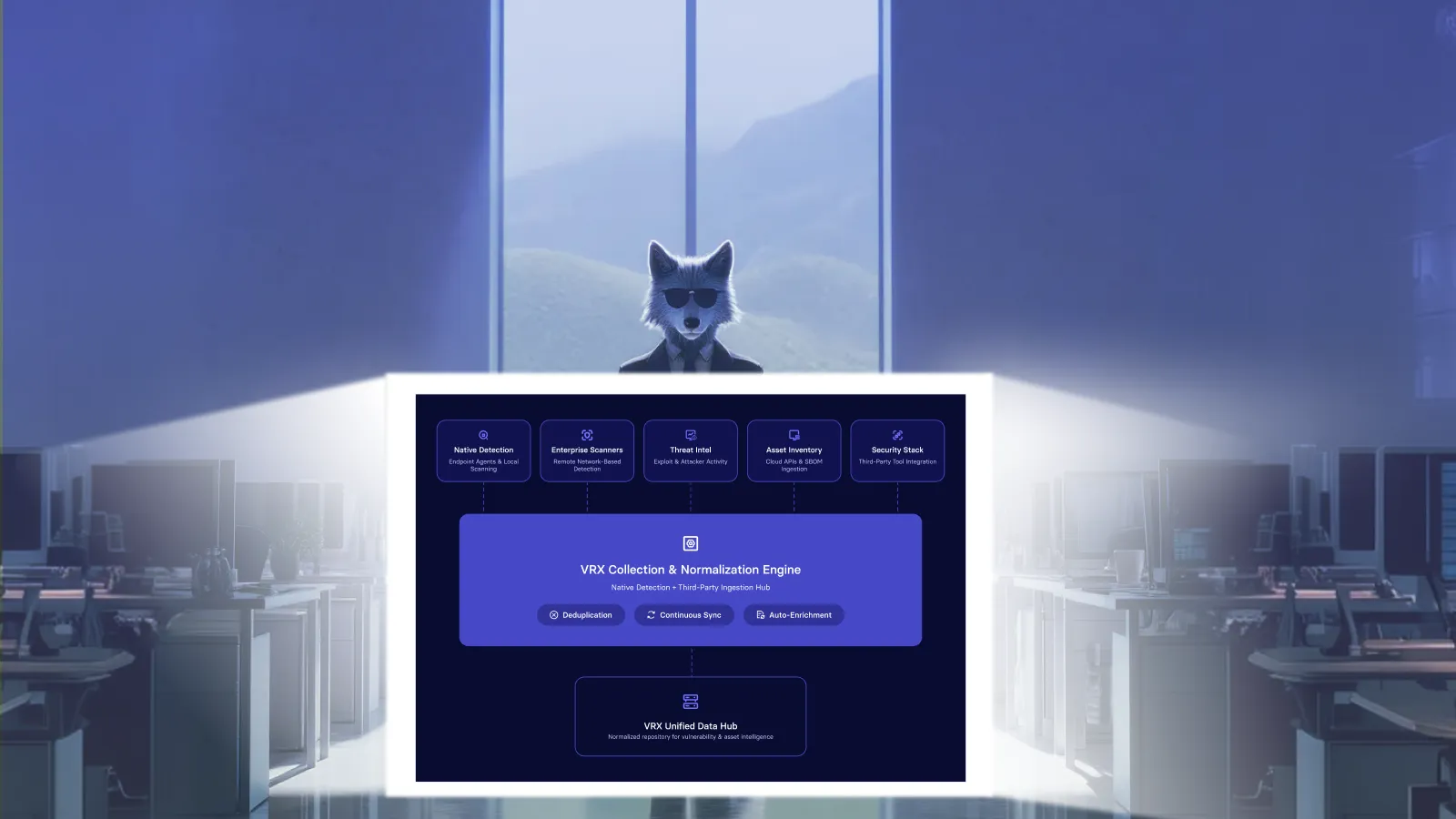
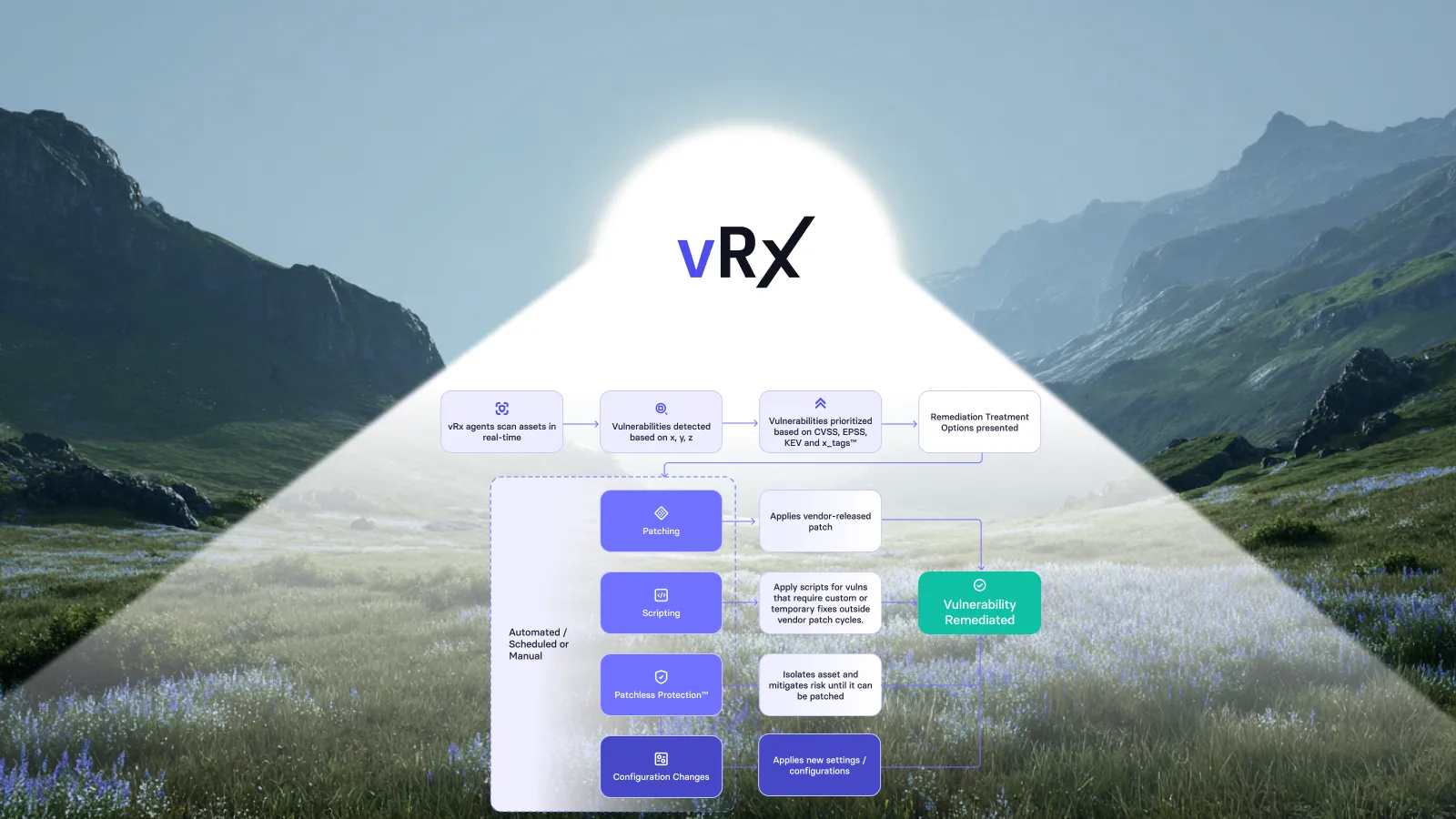
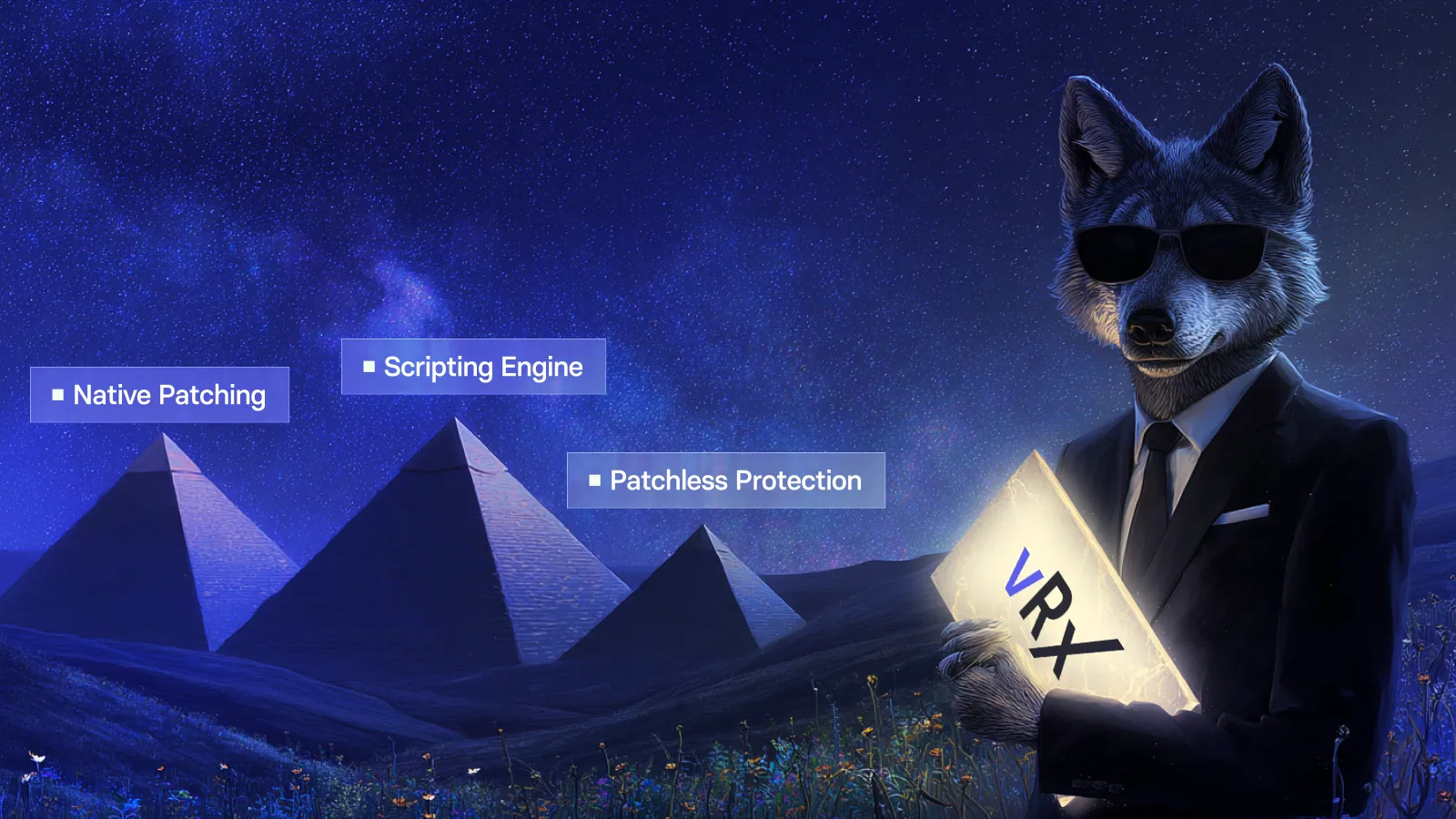
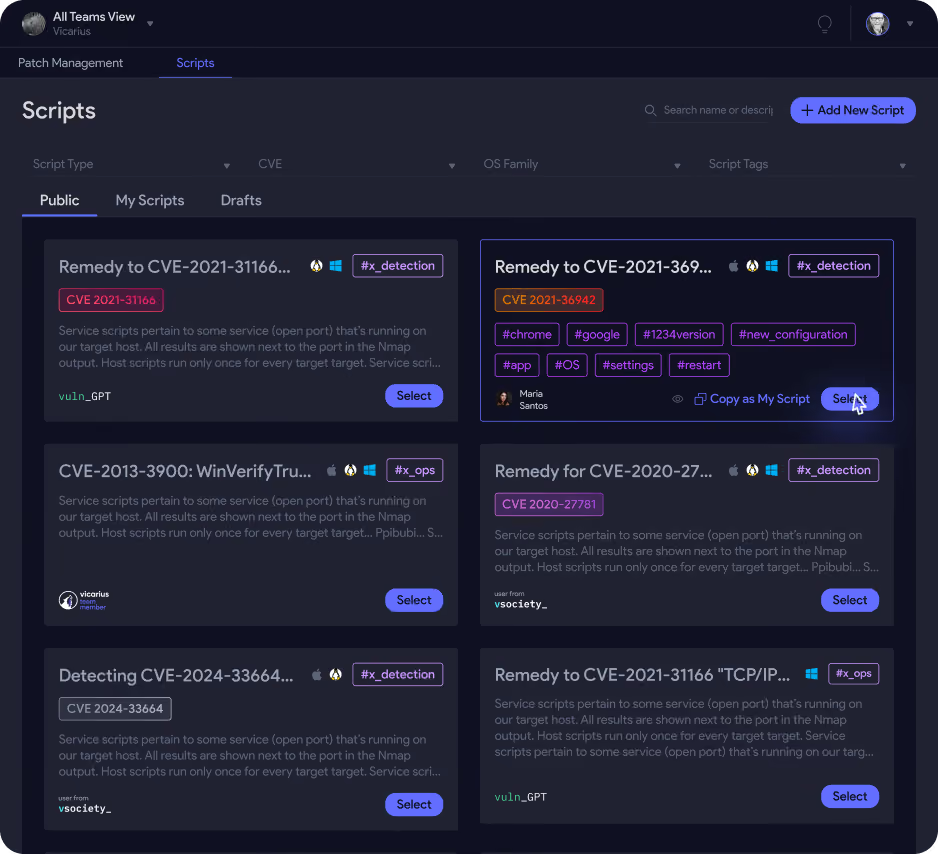
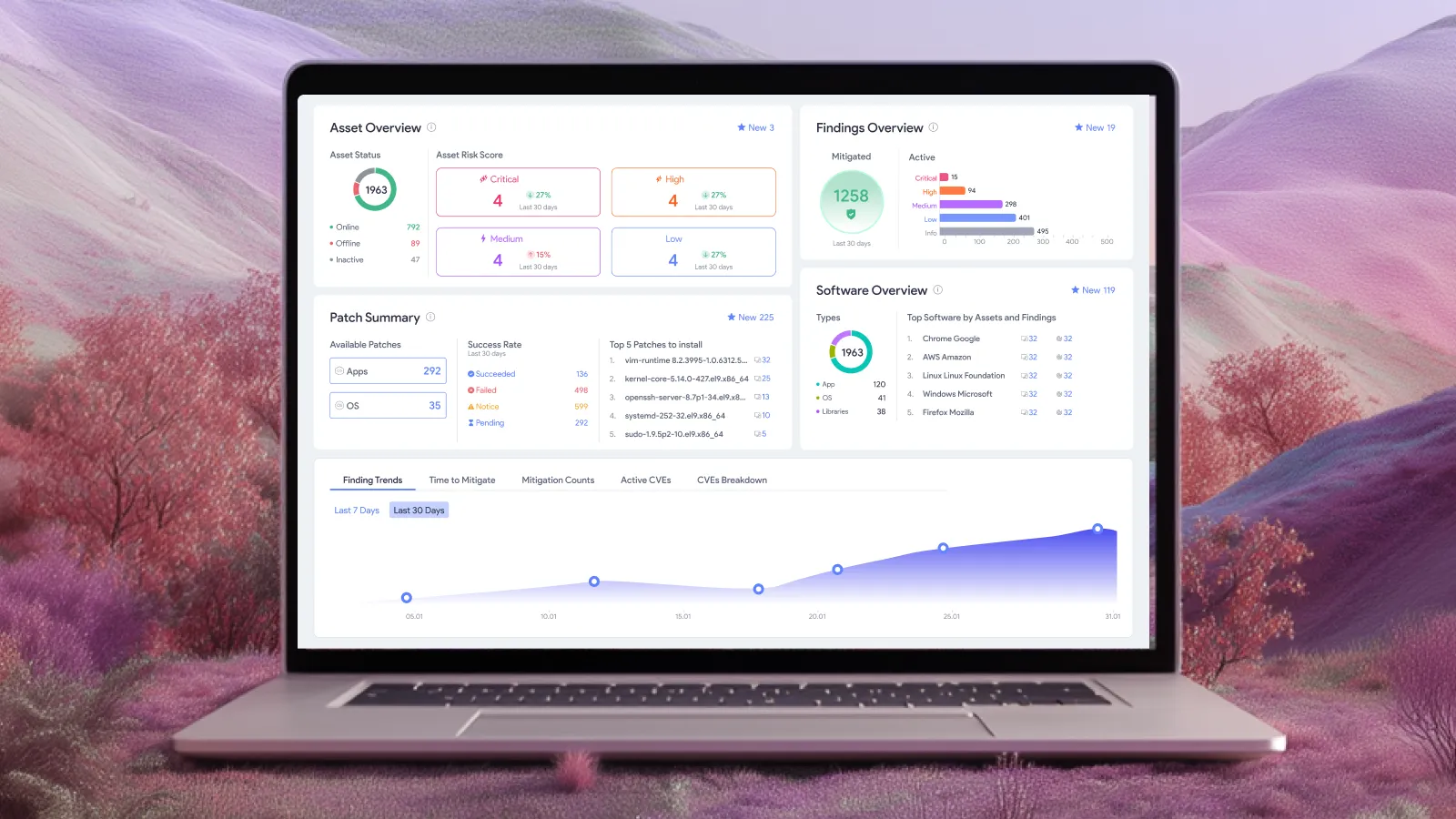
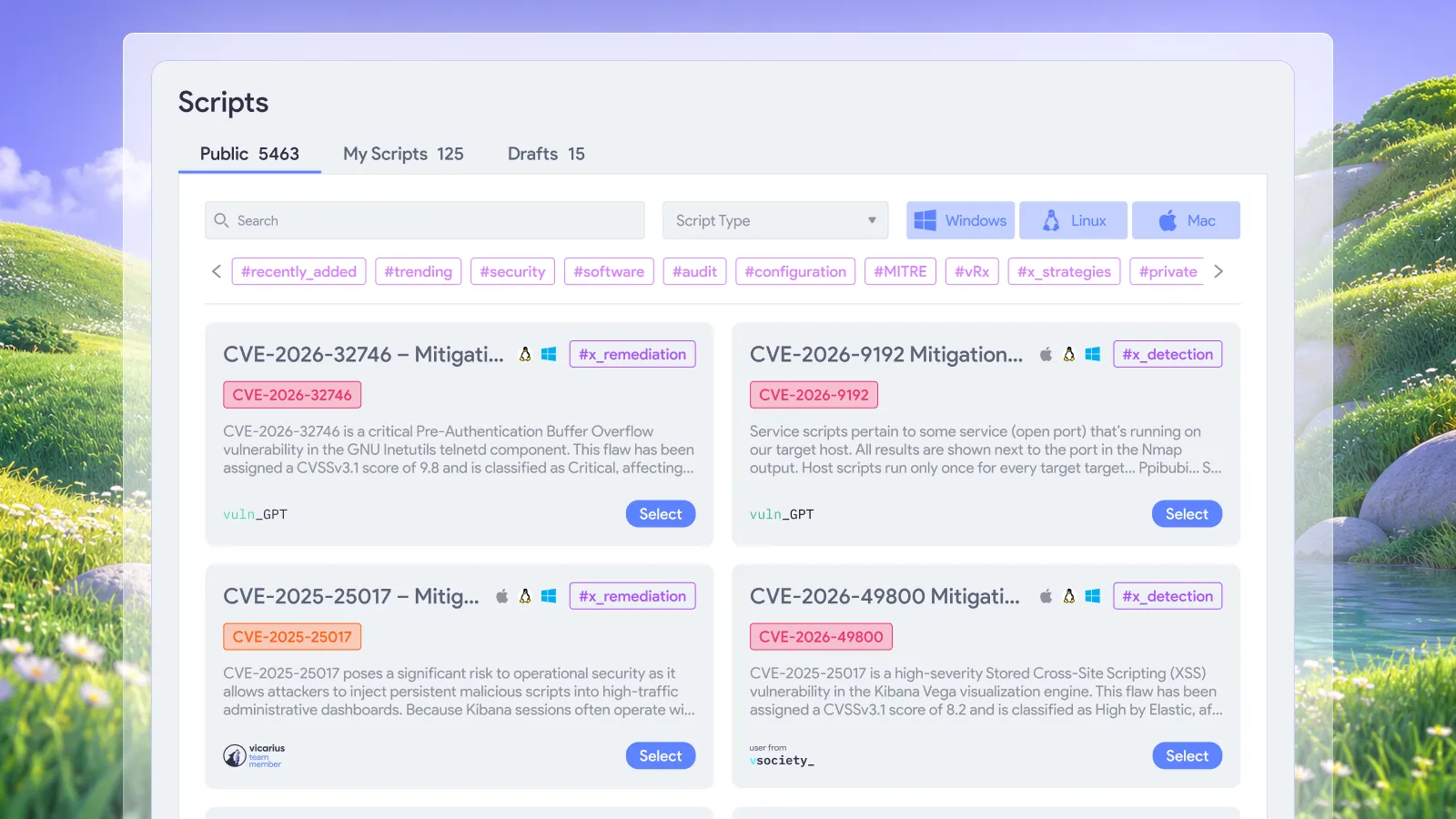
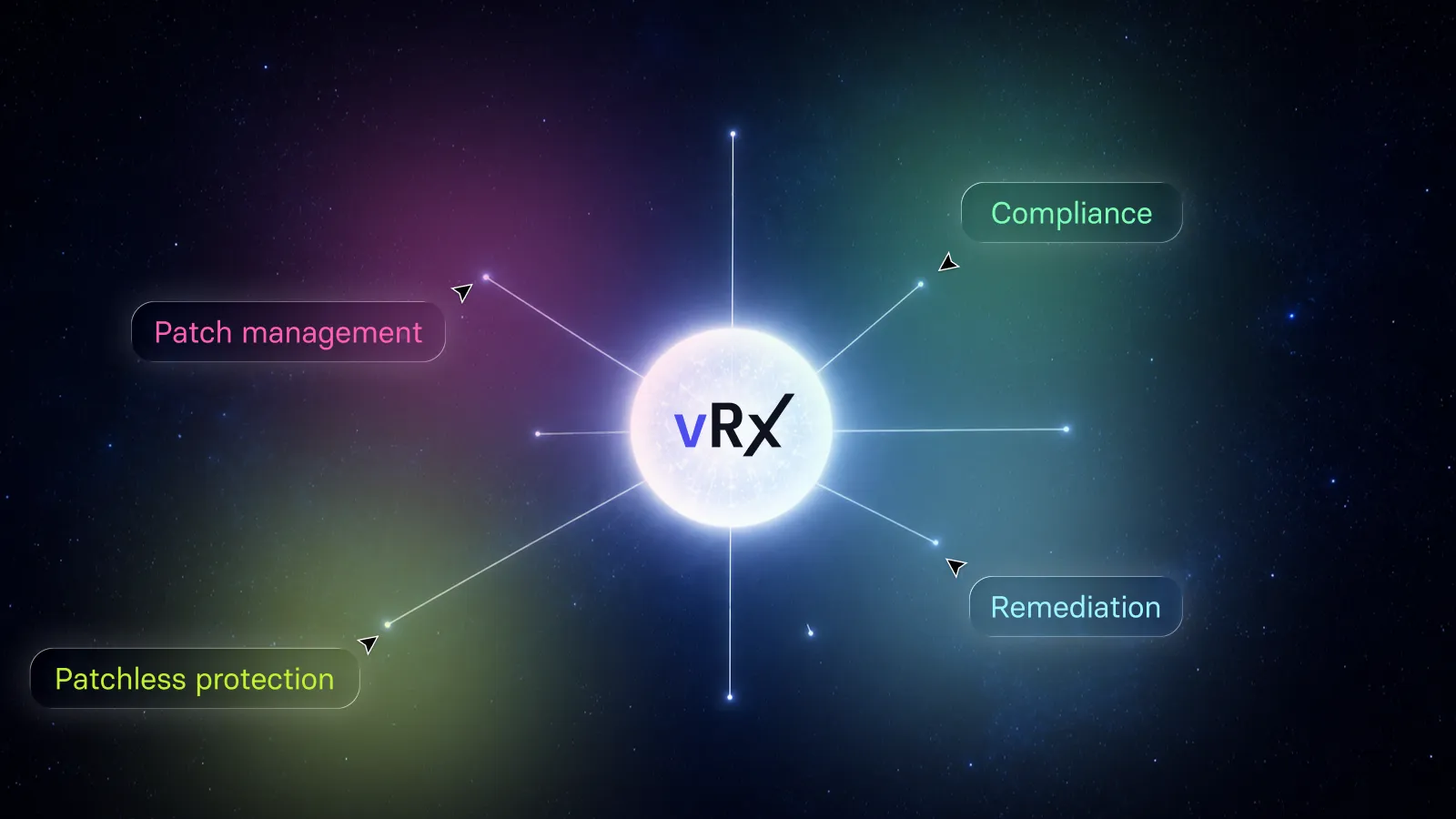
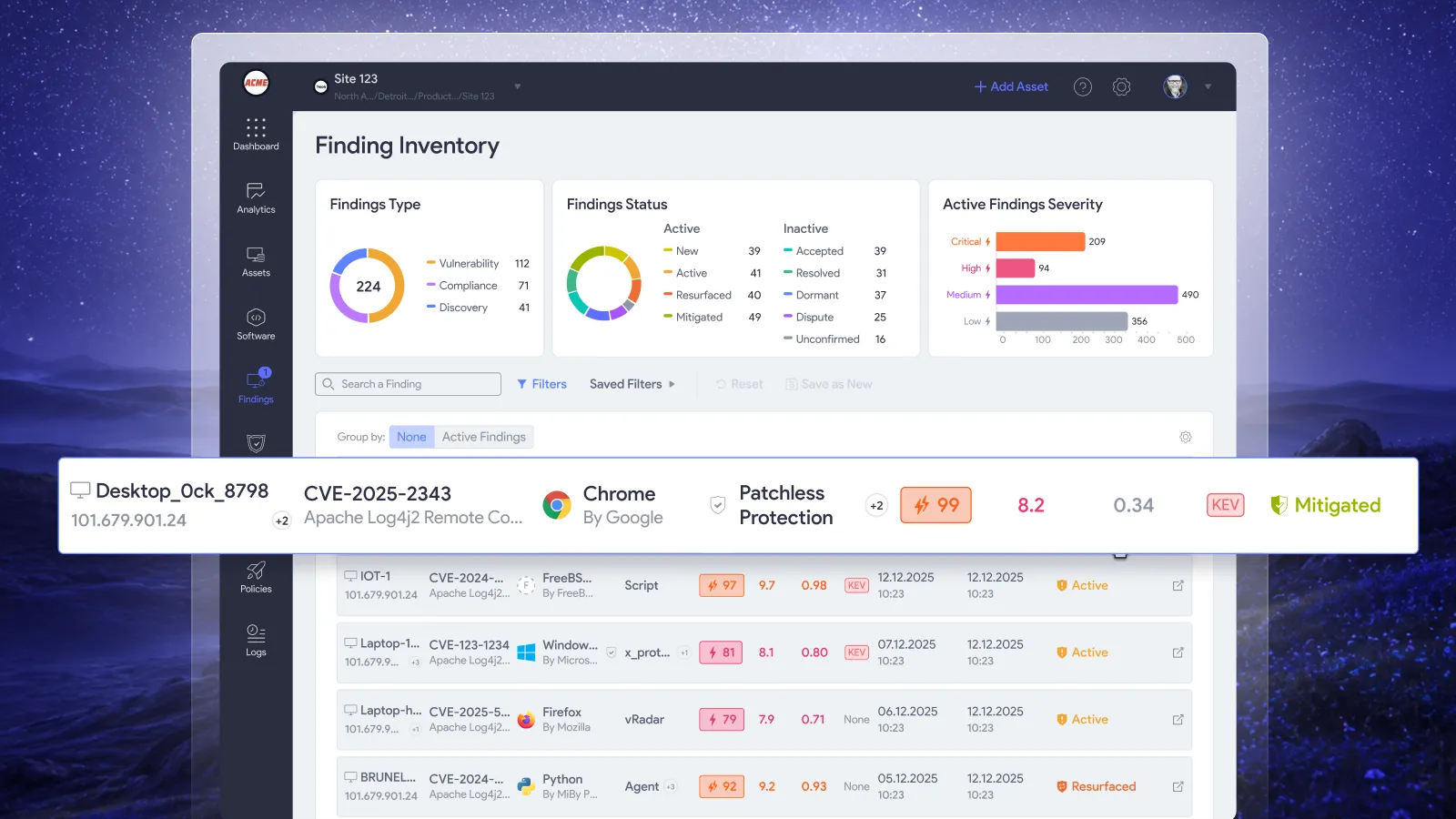
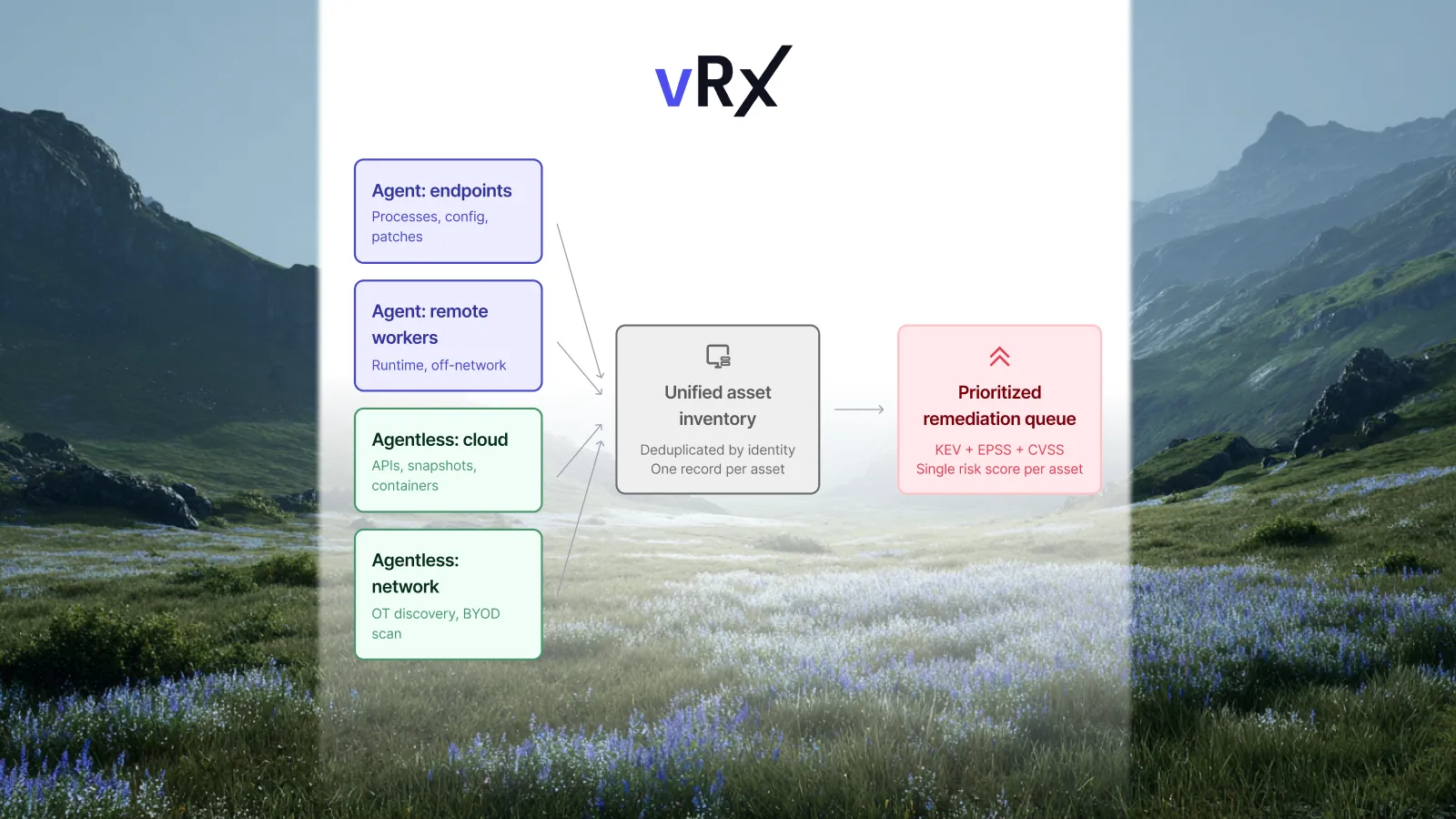
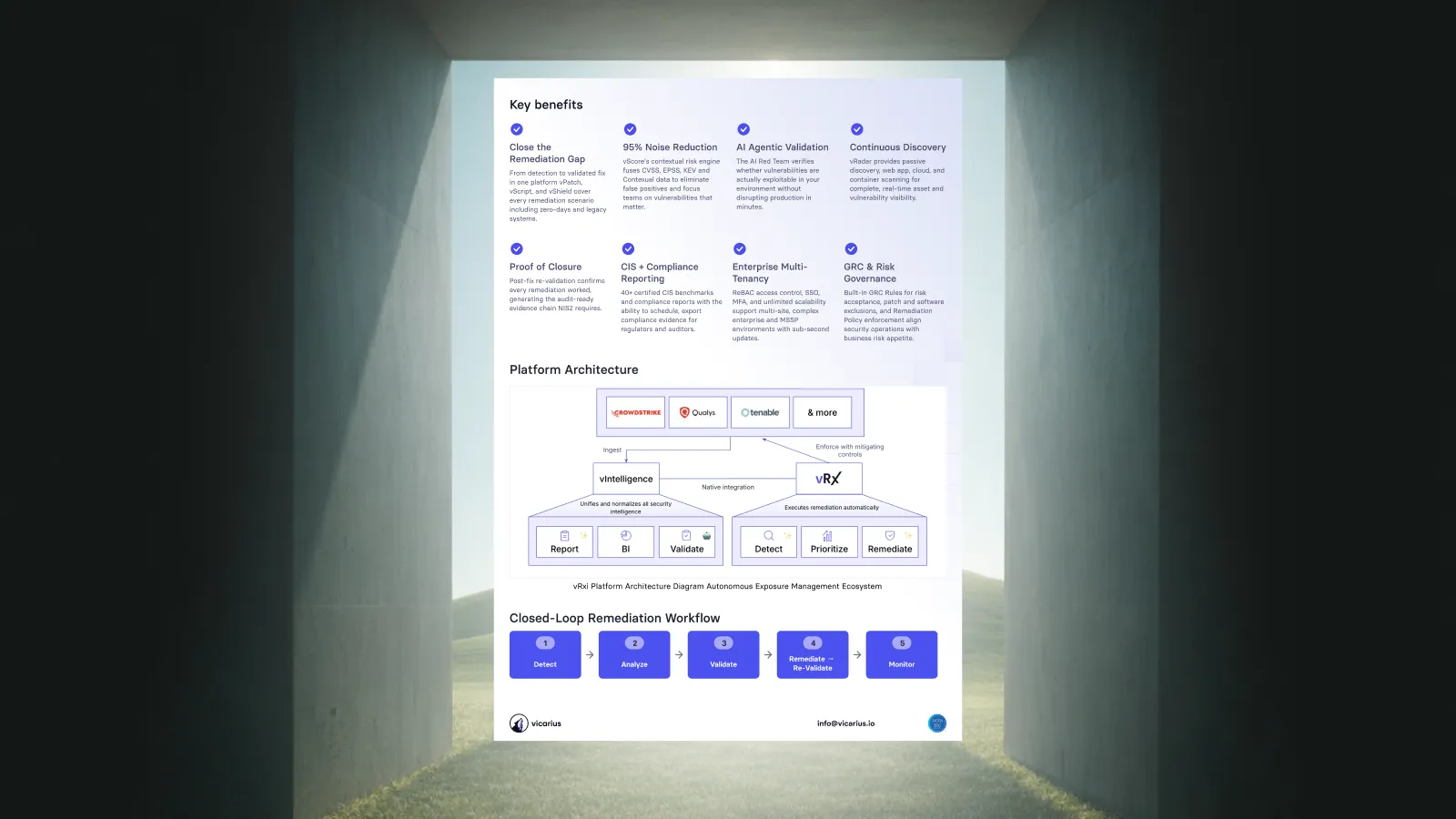
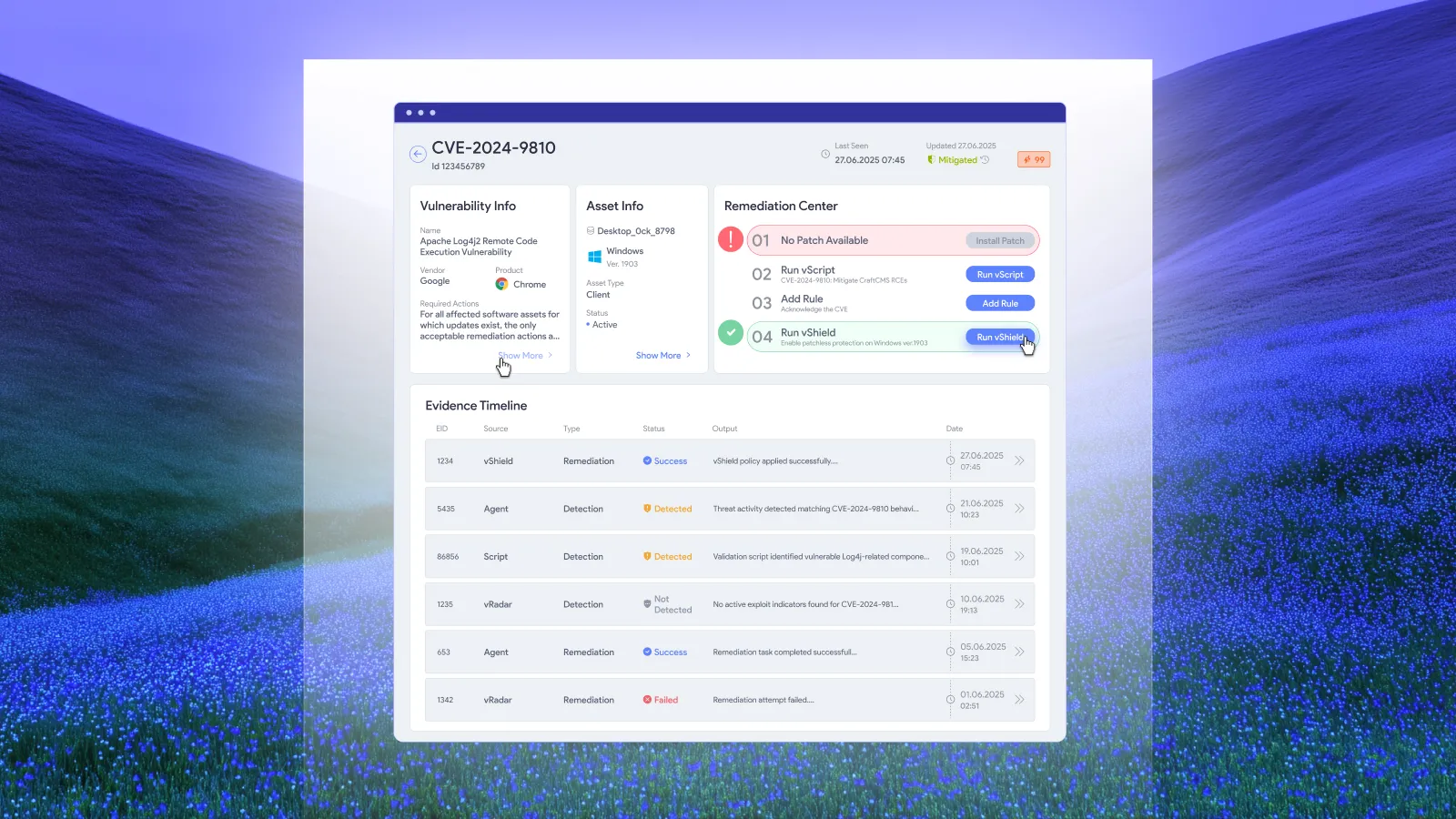
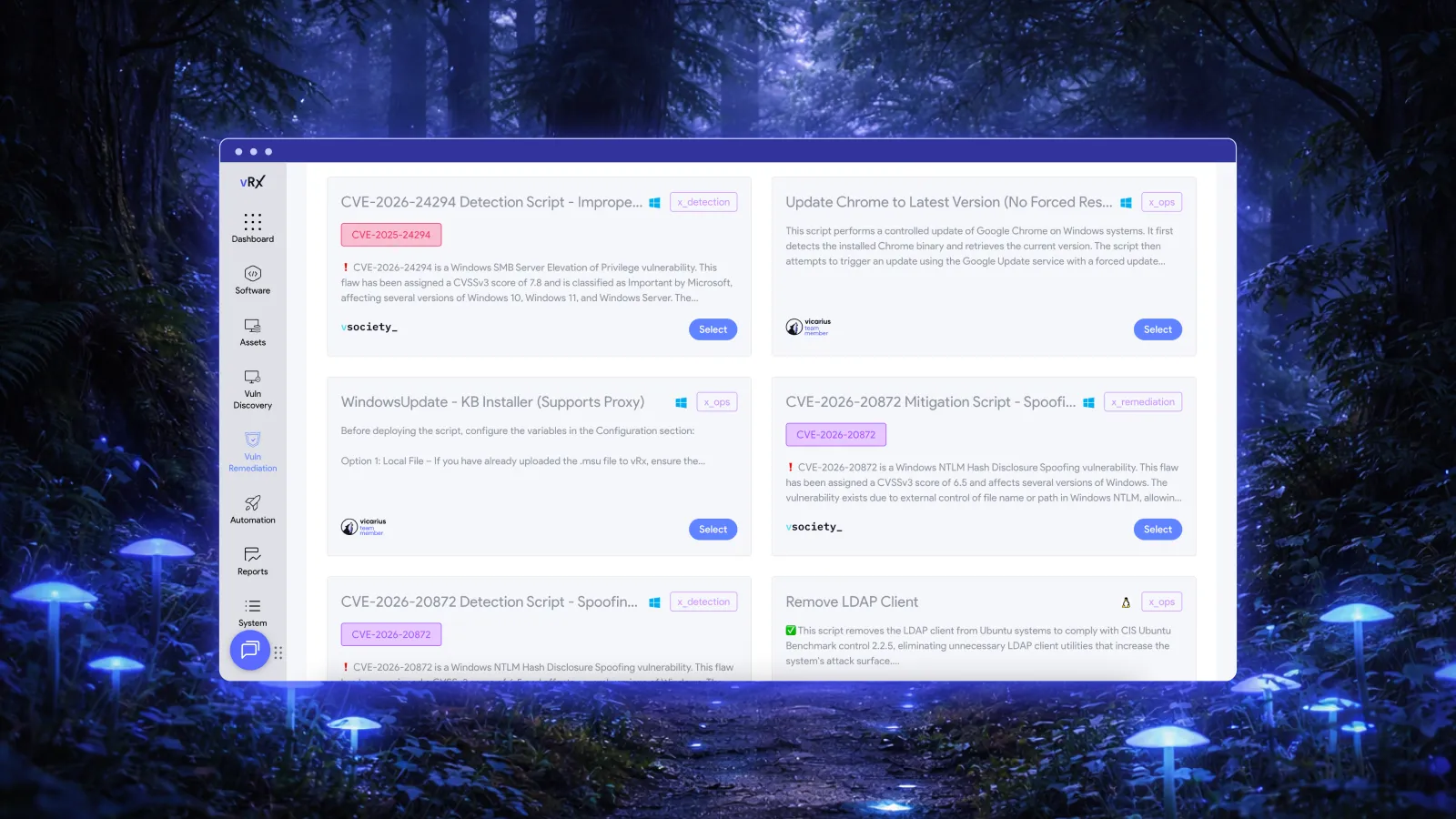
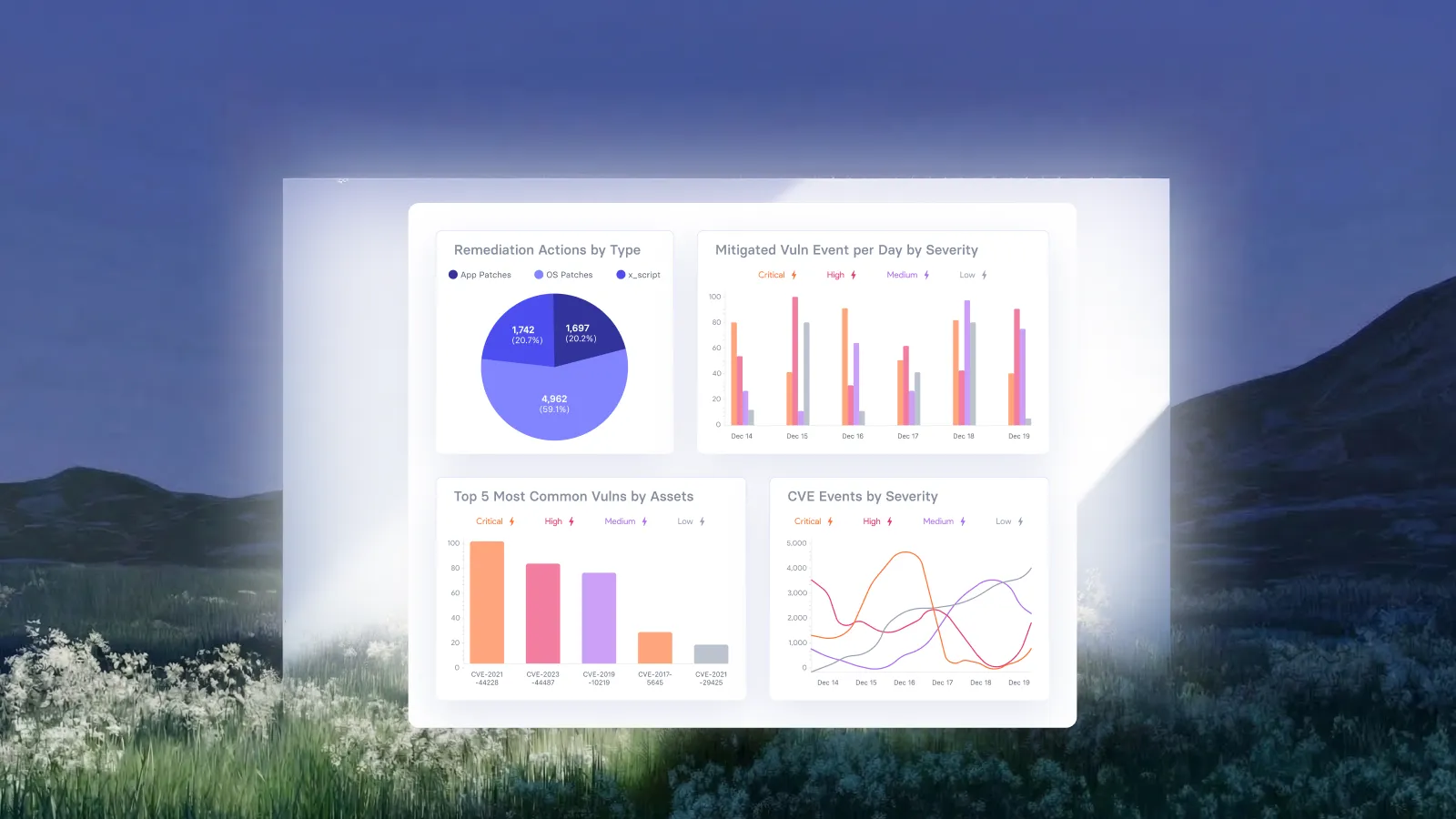
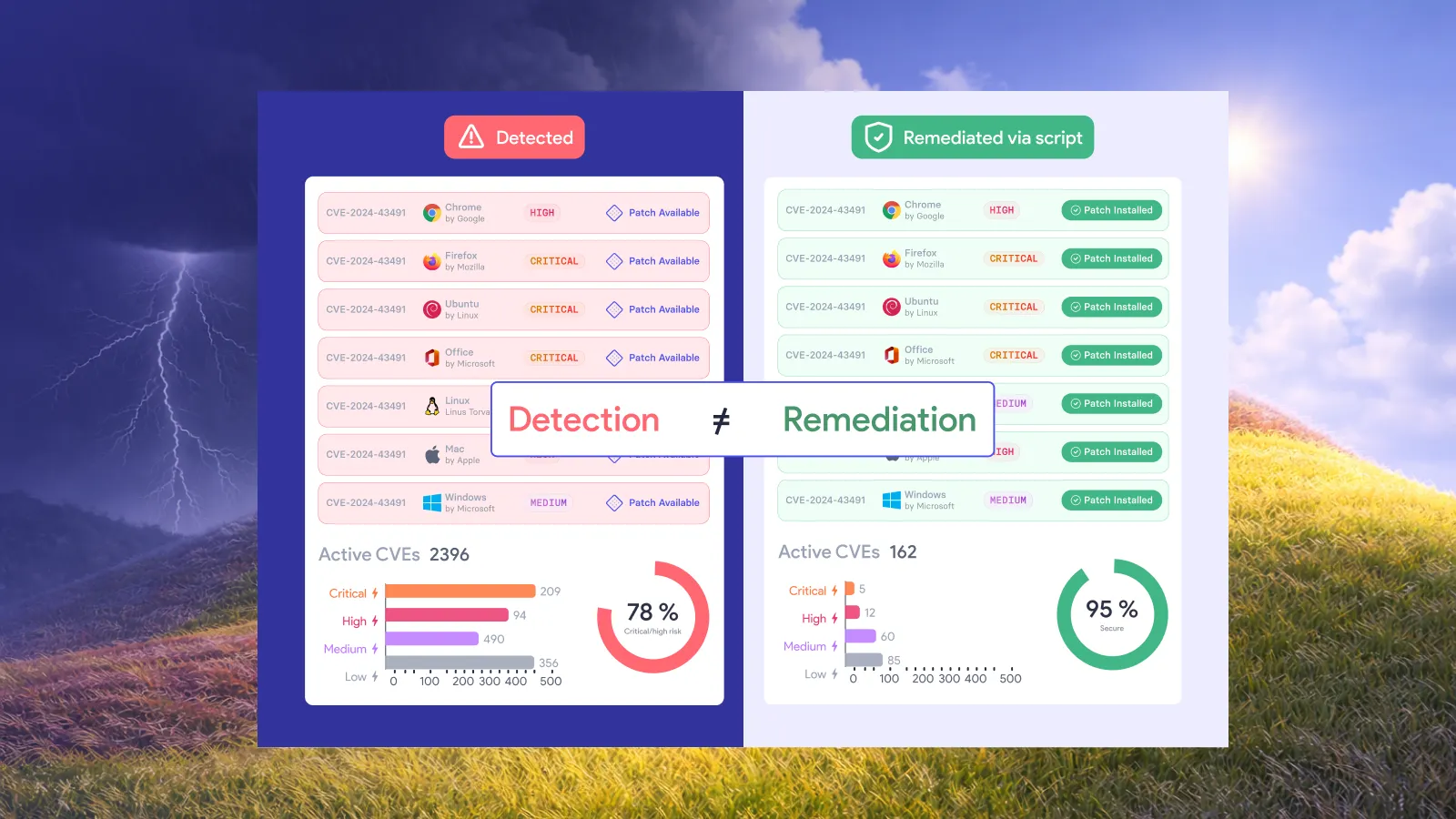
Vicarius is the only platform in this list built around the premise that detection and remediation belong in the same screen. vRx ships discovery, AI-driven prioritization and exploit validation through vIntelligence, patching for over 20,000 third-party apps and operating systems, scripted remediation, and Patchless Protection (vShield) in one console. The pitch is simple: most VM tools scan and report; vRx actually fixes. Gartner placed Vicarius as a Niche Player in the 2025 Exposure Assessment Platforms Magic Quadrant, and IDC named it a Major Player in the same category.
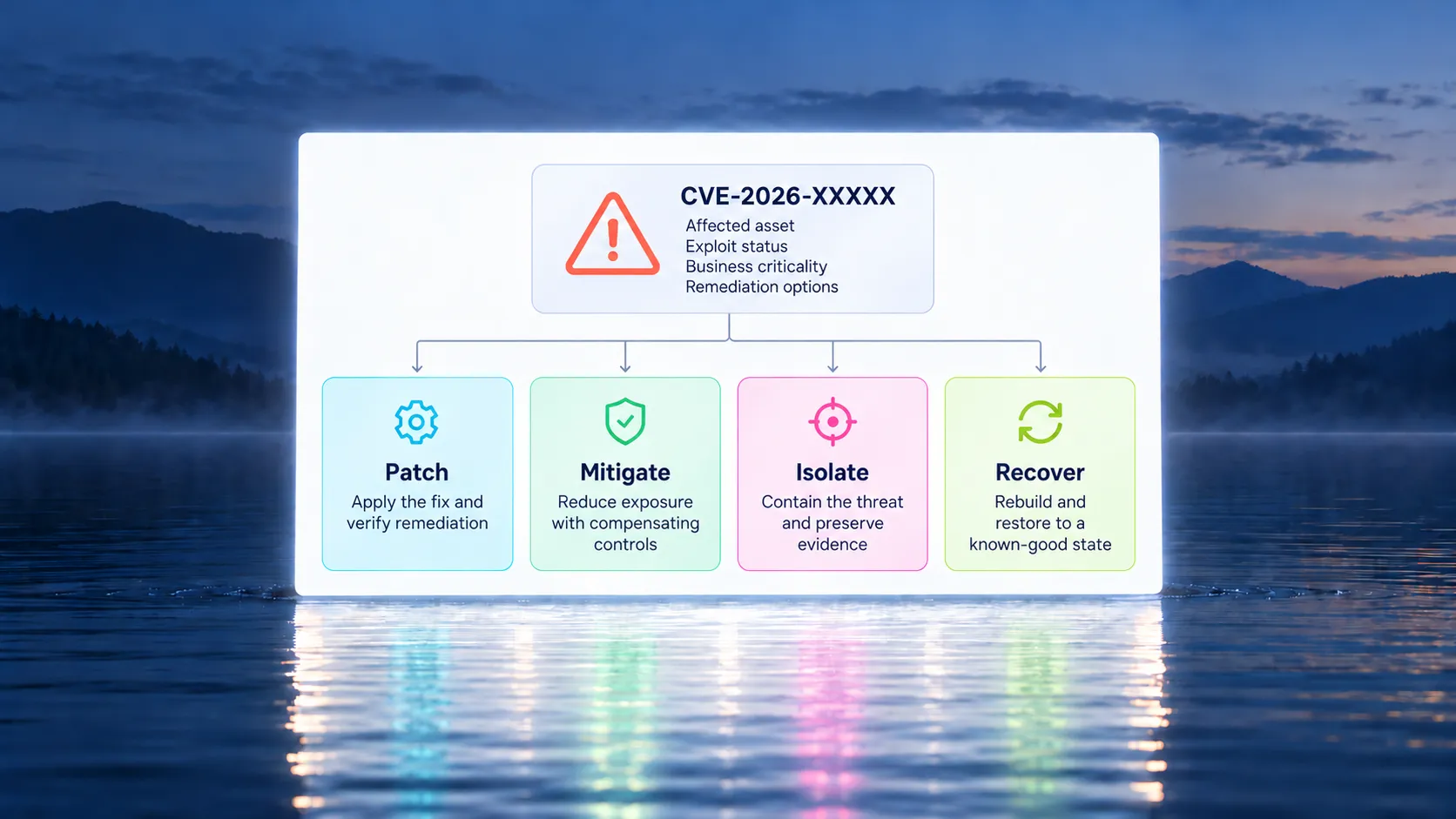
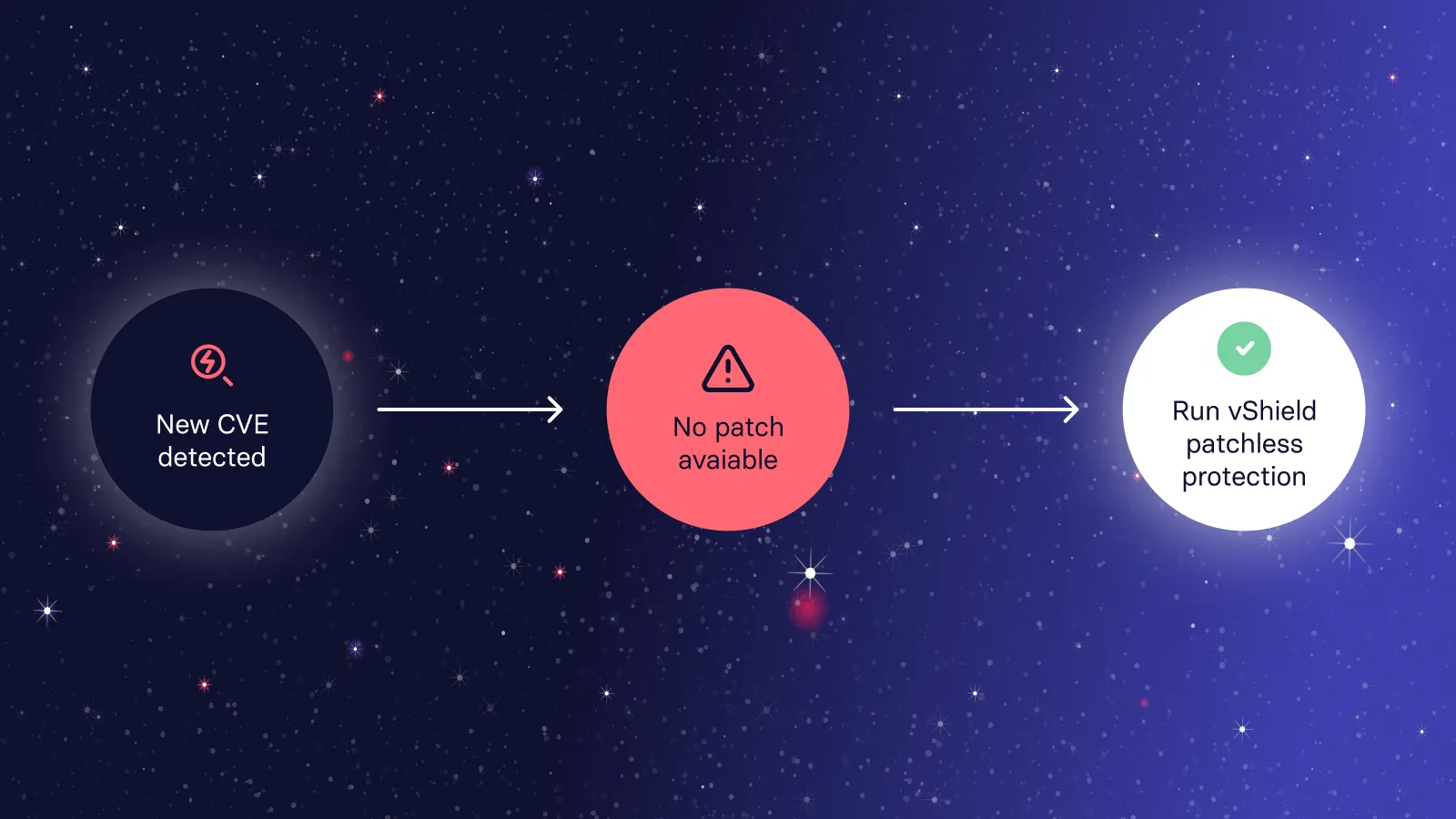
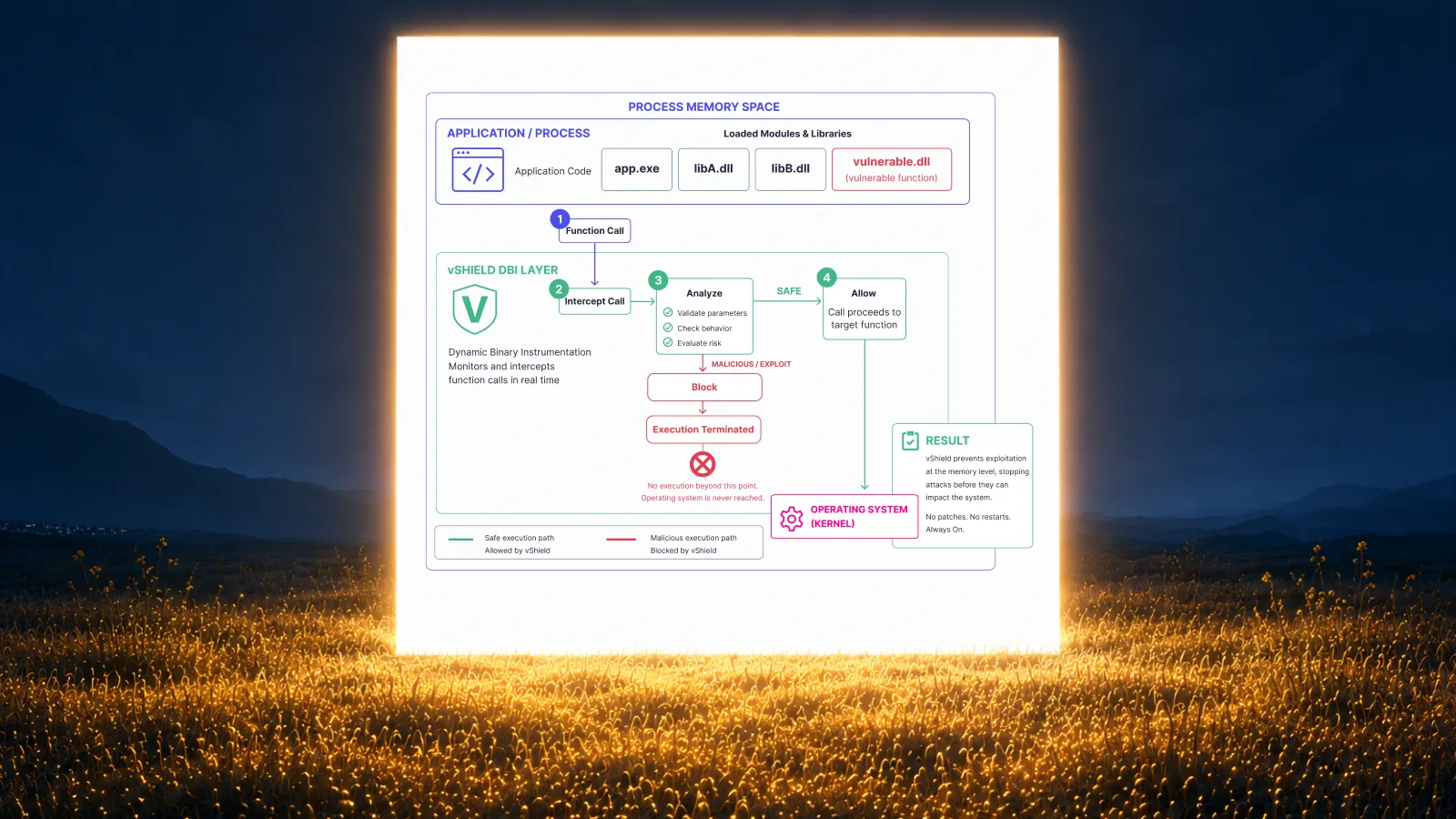
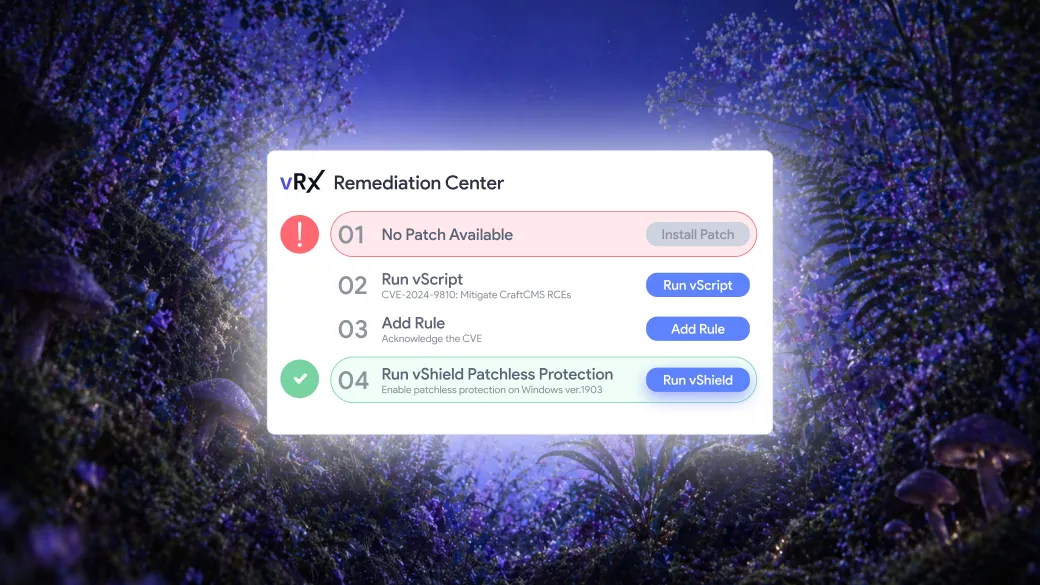
vShield is the differentiator worth a second look. When a CVE drops on an application that cannot be patched (an unsupported version, a third-party dependency, a Java library buried in a vendor app), vShield wraps the vulnerable functions in memory and blocks exploitation attempts until a longer-term fix is possible. That is a control most platforms in this list do not offer at all.
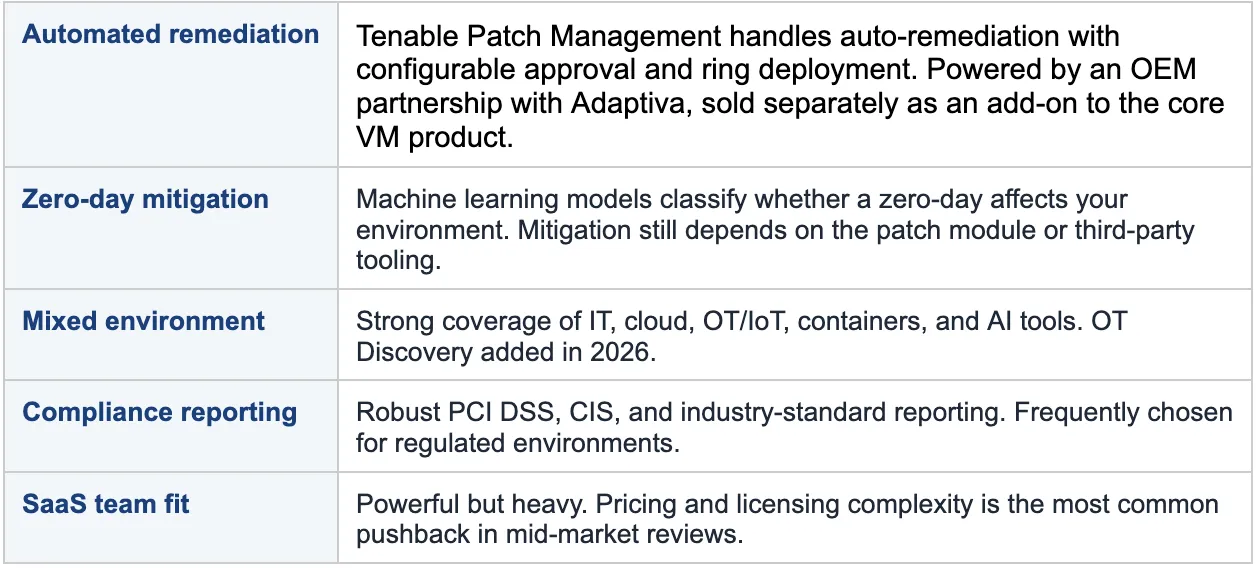
2. Tenable One
Tenable is the incumbent that defined vulnerability assessment, and in 2026 the company is positioning Tenable One as an AI-powered exposure management platform spanning IT, cloud, OT, identity, and AI workloads. The platform serves 44,000 customers globally and the underlying Nessus engine scans for over 110,000 vulnerabilities. Tenable Patch Management, launched as a paired module, finally brings autonomous patching into the same workflow as Vulnerability Priority Rating (VPR) prioritization.
The strength is breadth. The catch is that mid-market SaaS teams often only need a fraction of what Tenable One sells, and the pricing model can feel like buying an enterprise suite to solve a mid-market problem. SelectHub research lists entry pricing starting around $3,500 annually, and the asset-based licensing model gets complicated quickly when ghost IoT or VOIP devices consume seats.
3. Qualys Enterprise TruRisk Platform
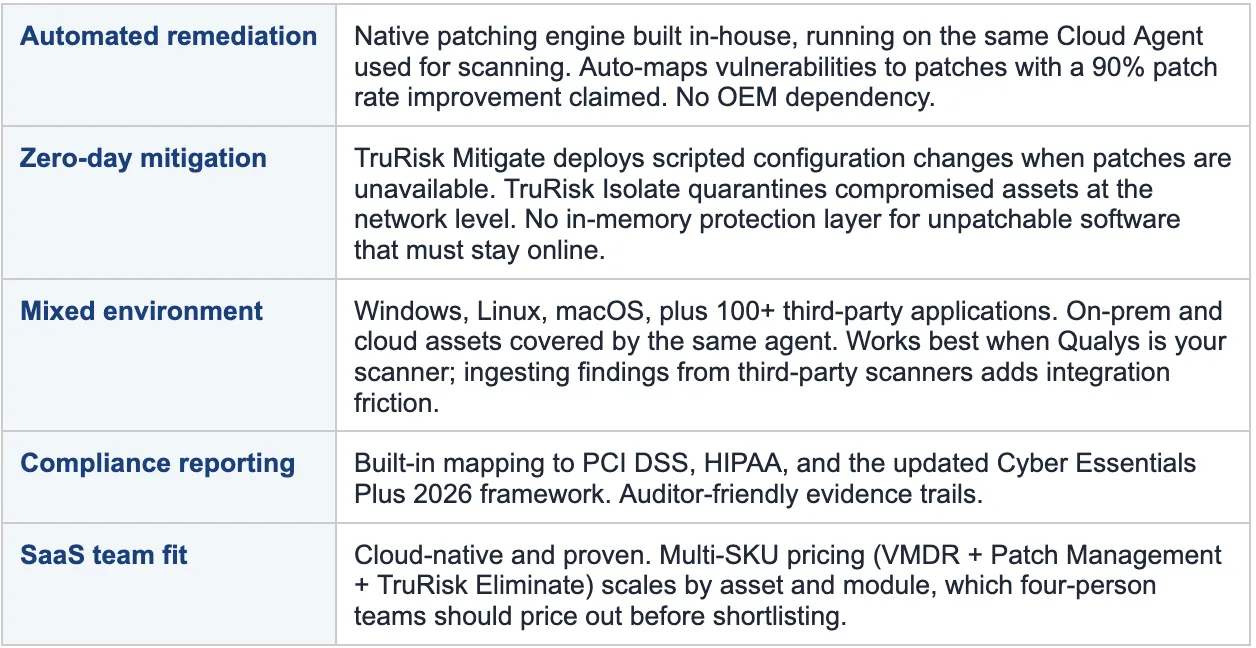
Qualys rebuilt its story around the Enterprise TruRisk Platform, which folds VMDR, Patch Management, TruRisk Eliminate, and CyberSecurity Asset Management into a single risk-scored workflow. Unlike Tenable, Qualys built its patching engine in-house roughly five years ago, running on the same Cloud Agent that handles vulnerability scanning. The 2026 investor narrative is explicit: customers move from VMDR alone (1x spend) to the full stack (3x spend) through platform consolidation. Cintas, a public reference customer, reported a 61% cyber risk reduction after layering Patch Management onto VMDR and patching the most severe threats within 24 hours.
TruRisk Eliminate is the piece worth attention for SaaS teams that operate beyond the patch. Qualys consolidated three remediation actions under this umbrella: Patch Management for traditional patching, TruRisk Mitigate for scripted configuration changes when no patch is available (disabling services, modifying registry keys, closing ports), and TruRisk Isolate for quarantining compromised Windows and Linux assets at the network level. That gives Qualys the broadest remediation toolkit in this list outside of Vicarius. The gap: there is no in-memory protection layer. When the asset cannot be patched and cannot be taken offline, Qualys runs out of options. Pricing stacks accordingly: VMDR, Patch Management (around $30 per asset per year), and TruRisk Eliminate are separate SKUs, each with its own license activation.
4. Rapid7 Exposure Command
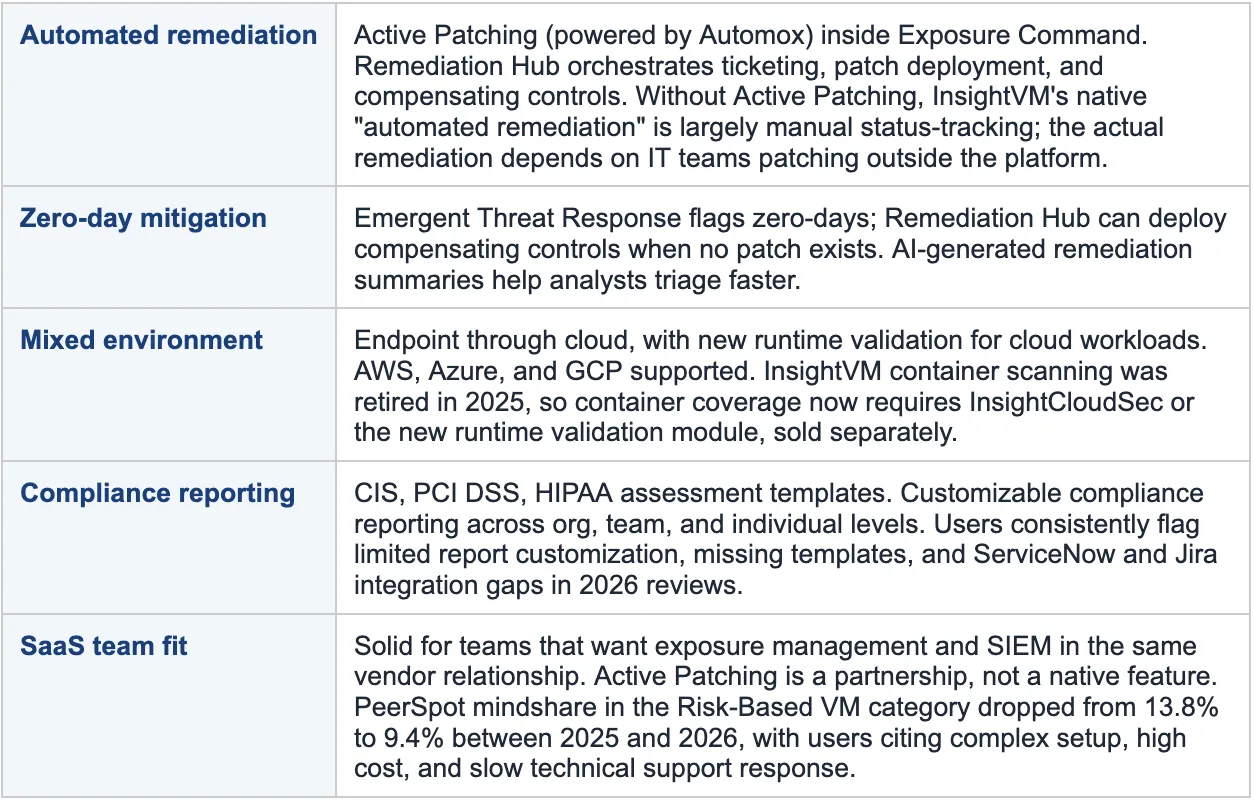
Rapid7 spent 2025 and 2026 rebranding its stack around Exposure Command, an exposure management layer that sits on top of InsightVM, Surface Command, and InsightCloudSec. The platform was named a Leader in the 2025 Gartner Magic Quadrant for Exposure Assessment Platforms. In March 2026, Rapid7 added runtime validation and Data Security Posture Management, using eBPF sensors to confirm which vulnerabilities are actually exploitable in production.
Active Patching, powered by Automox, is the remediation engine. Rapid7 partnered with Automox rather than building its own, which means SaaS teams get a fully automated patching solution embedded in Exposure Command without a separate procurement. The trade-off is that the patching layer is a different vendor under the hood, with its own support contract.
The architectural catch: InsightVM is hybrid, not purely cloud-native. It requires an on-premises Security Console (a server running PostgreSQL, the web interface, and reporting, typically 32 GB of RAM allocated and reserved, x86_64 only, no containerization support). Tenable.io and Qualys ship pure cloud platforms; Rapid7 customers maintain console infrastructure.
5. ManageEngine Endpoint Central
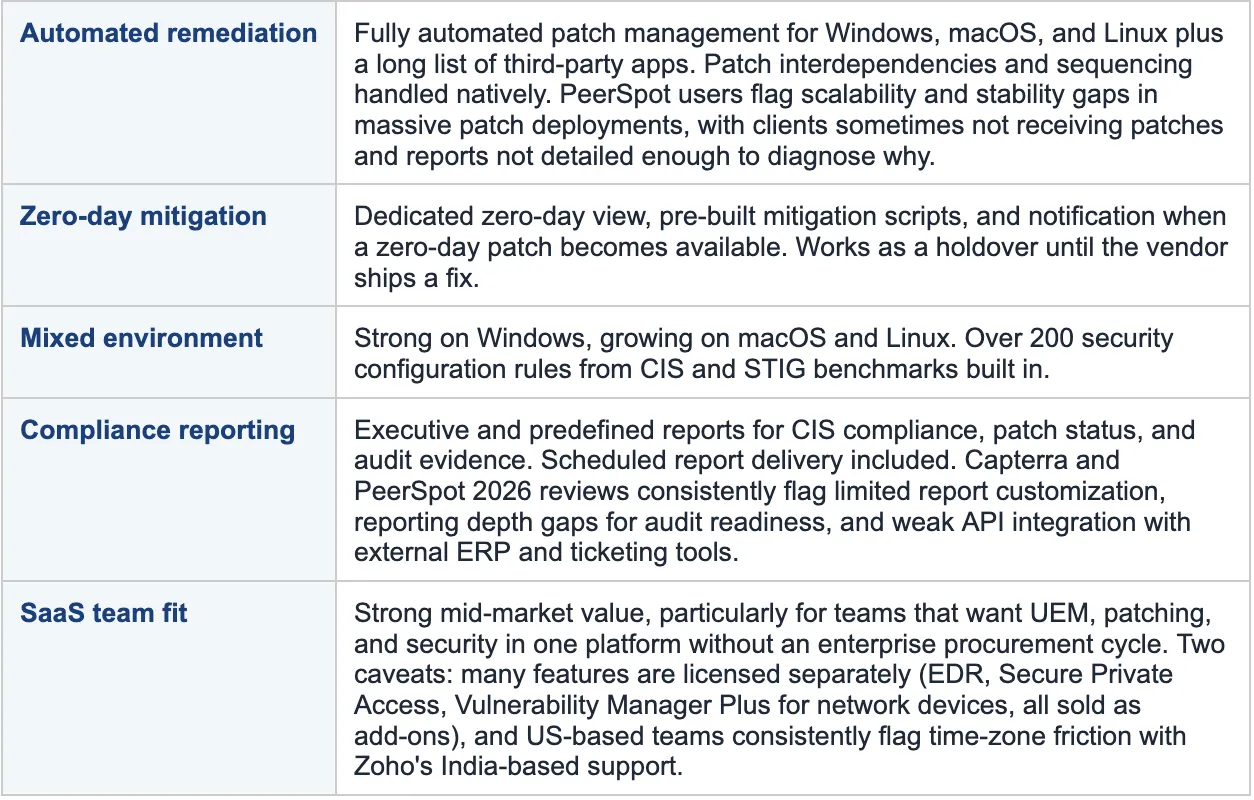
ManageEngine consolidated vulnerability management into Endpoint Central, the company's unified endpoint management platform, and in March 2026 expanded the suite further by adding EDR and Secure Private Access. The pitch is one agent, one console, covering patch management, vulnerability scanning, configuration auditing, EDR, and zero trust access. For a SaaS IT team that also handles security, that breadth is hard to ignore.
Endpoint Central is the most aggressively priced platform in this list, and it shows in the user base. The free edition covers up to 25 endpoints. Paid tiers scale per endpoint without the asset-class licensing gymnastics common at the enterprise scanners. The honest trade: macOS vulnerability management is still under active development with a mid-2026 target, and network device firmware scanning lives in the separate Vulnerability Manager Plus product.
ManageEngine's own FAQ states Vulnerability Management for macOS is "under active development" and "expected to be released by mid-2026." Patch Management works on Mac, but vulnerability detection does not. For a SaaS team running a Mac-heavy fleet, this is a real gap, not a roadmap caveat.
One more honest data point: ManageEngine products have a recurring presence on the CISA Known Exploited Vulnerabilities catalog. CVE-2021-44757 in Desktop Central allowed remote unauthenticated code execution. CVE-2021-37415 in ServiceDesk Plus made the KEV list. CVE-2024-10203 in Endpoint Central (CVSS 7.8) was disclosed and patched in September 2024. CVE-2024-38868, an authorization bypass affecting device isolation, was disclosed in 2024 with patches issued. For a platform whose job is fixing vulnerabilities, its own track record warrants scrutiny.
6. Ivanti Neurons for Patch Management
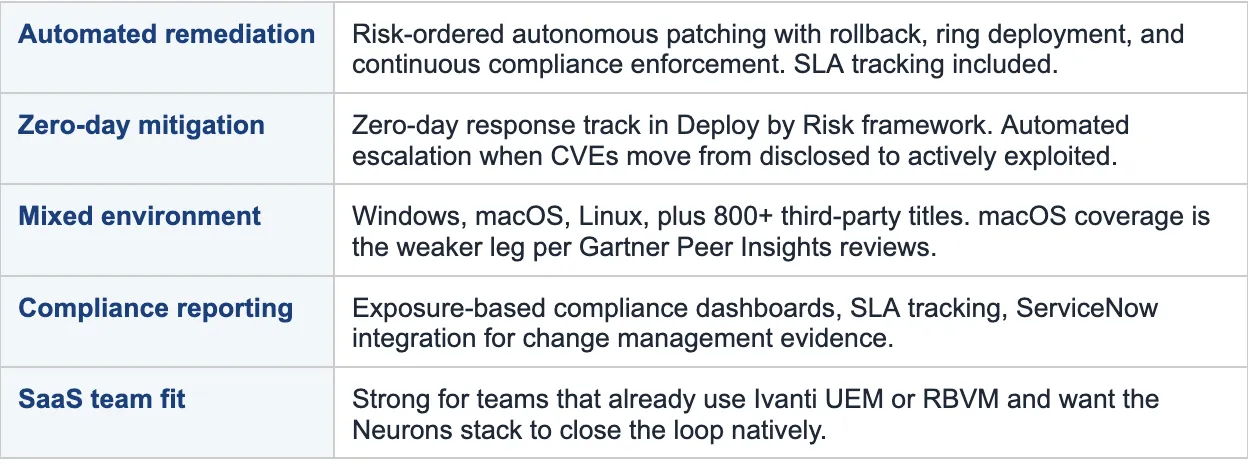
Ivanti Neurons is the part of the Ivanti stack that competes most directly here. Built on the broader Autonomous Endpoint Management platform, Neurons for Patch Management combines Vulnerability Risk Rating (VRR), automated bot workflows, and a unified System of Record across Windows, macOS, Linux, and roughly 800 third-party applications. The VRR scoring model is notable because it is independent of the NIST NVD, which matters now that NVD has scaled back enrichment for non-KEV CVEs.
The Deploy by Risk framework lets teams run three parallel patching tracks: routine maintenance, priority updates, and zero-day response with immediate execution. For a SaaS team trying to avoid patch storms that degrade network performance, that parallelism is genuinely useful. The macOS experience trails the Windows experience in user reviews, and the platform expects a pricing model with a base platform fee plus per-device licensing.
7. Automox
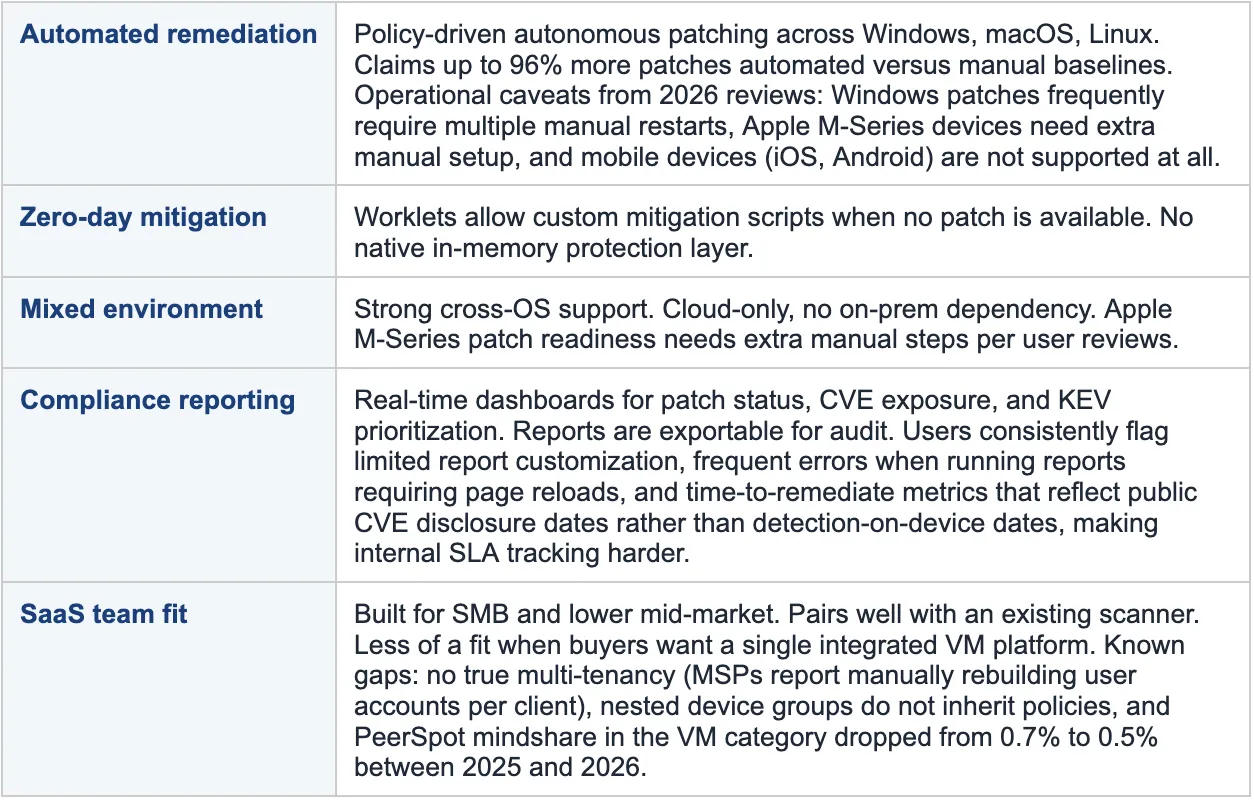
Automox is positioned as autonomous endpoint management for small to medium enterprises. The platform is cloud-native, agent-based, and policy-driven, with Worklets (customizable scripts) handling everything that does not fit a standard patch. The 2026 State of Endpoint Management Report, published by Automox itself, found that only 6% of organizations have achieved full endpoint automation, and the company built its entire pitch around closing that gap.
Automox does not run its own vulnerability scanner. By design. Vulnerability Sync ingests CSV reports from CrowdStrike Falcon Spotlight, Tenable, Qualys, and others, then maps findings to patches or Worklets for remediation. For teams that already own a scanner and want a remediation layer, that is a feature. For teams that want one tool that scans, scores, and fixes, Automox is structurally only half the platform.
The architectural catch: every endpoint pulls patches directly from the internet. There is no on-premises repository or distribution point, which Automox confirms in its own FAQ. Patch 1,000 devices on the same office network, and 1,000 devices each download the same patch. macOS Content Caching is the only workaround in Automox documents.
8. NinjaOne Vulnerability Management
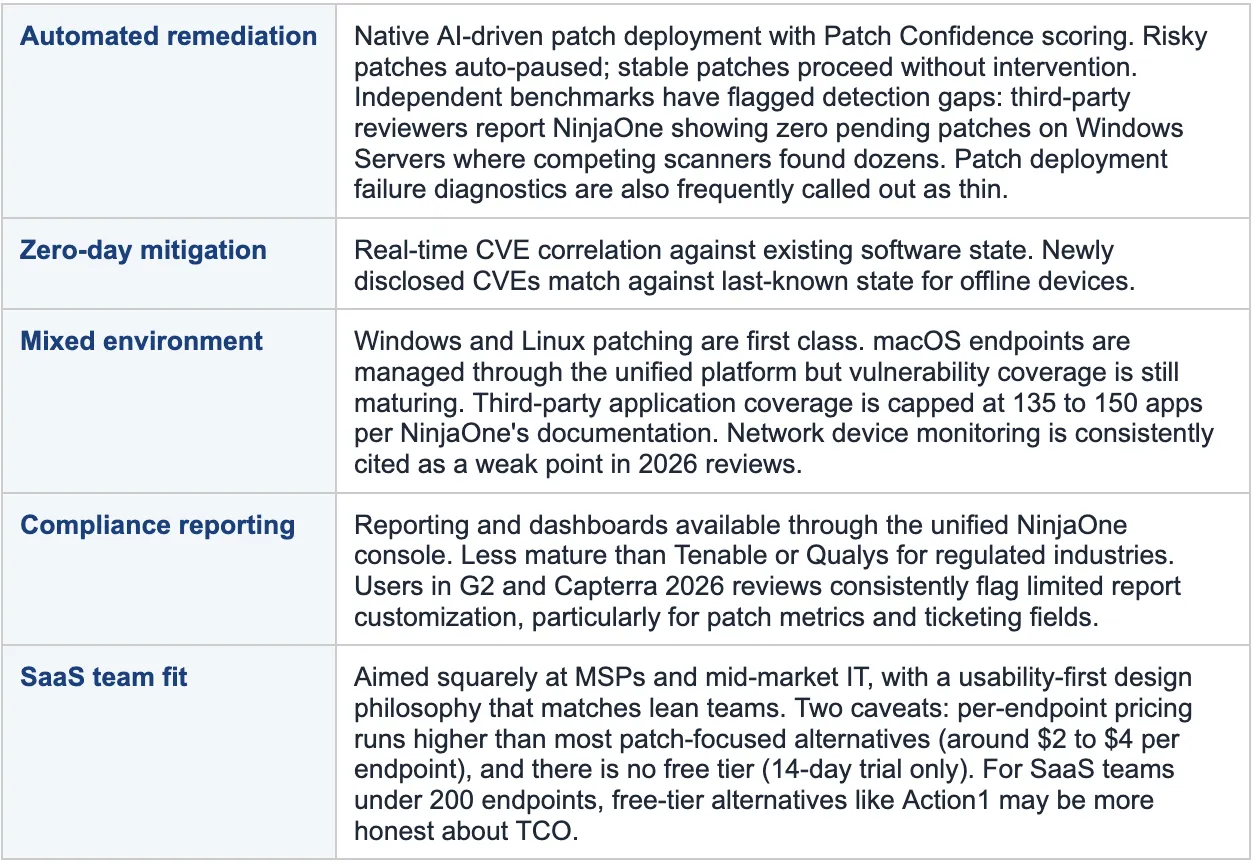
NinjaOne is the newcomer to consolidated VM, having launched its native Vulnerability Management product in March 2026. The platform is built on top of NinjaOne's existing patch management engine (rated number one in G2's Winter 2026 Patch Management report with a 93% Ease of Use score) and adds scan-free, real-time vulnerability assessment plus AI-driven Patch Intelligence that pauses risky CVEs while stable updates proceed. The product is months old, and early reviews are mixed: one verified Capterra reviewer in November 2025 reported that NinjaOne's vulnerability management "was extremely poor and missed so many vulnerabilities" in side-by-side trials with competitors. Buyers shortlisting on the strength of the patch management heritage should pilot the new VM module separately.
The architectural trade-off: NinjaOne is an RMM platform that added VM, not a VM platform that added remediation. Third-party patch coverage tops out around 135 to 150 applications per NinjaOne's own docs, well below the 1,000+ that ManageEngine and Vicarius support. For SaaS teams with a wide application footprint, that ceiling is the constraint that matters.
9. Action1
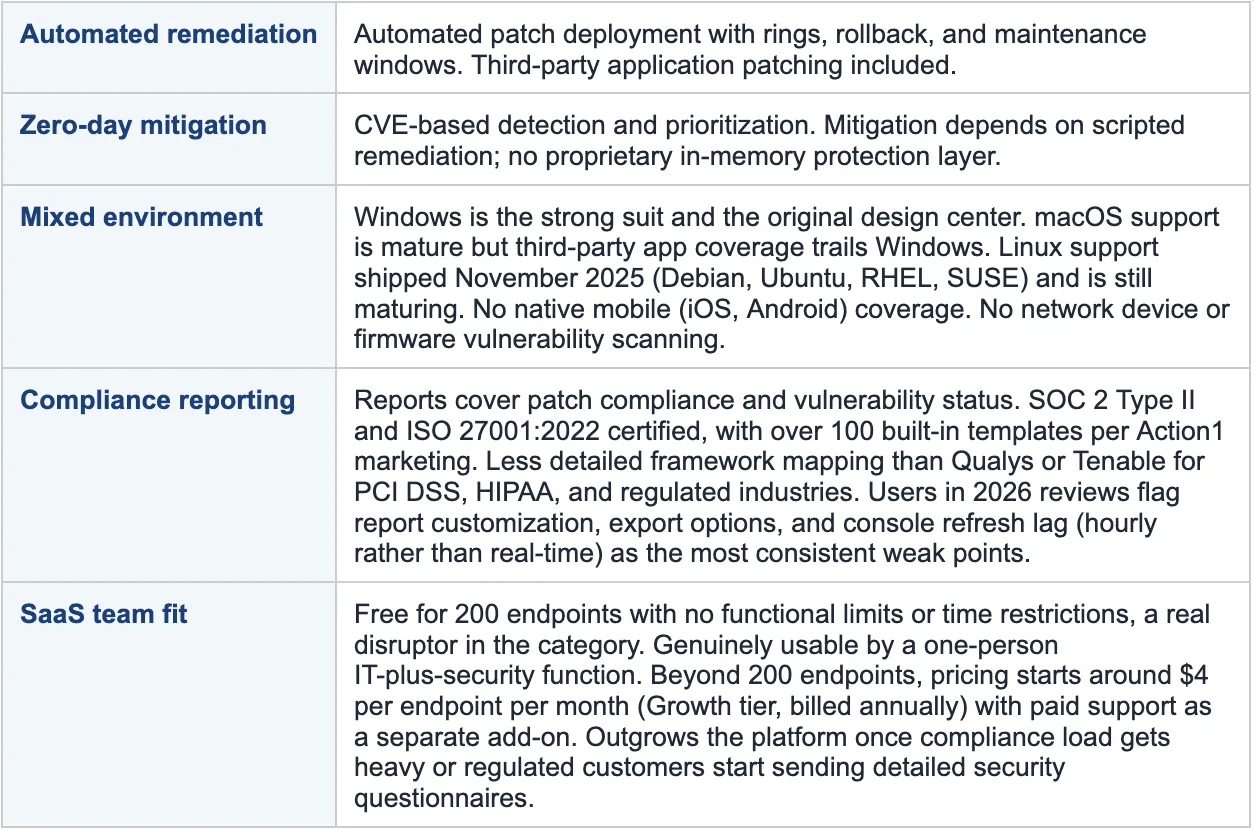
Action1 is the leanest entry on this list. The platform is cloud-native, agent-based, and free for the first 200 endpoints, which makes it a common starting point for SaaS companies in early growth before a security team exists. Vulnerability detection and patch management share a single console, including third-party application patching from Action1's privately maintained software repository.
The pricing model is the headline. The product capabilities are competent rather than category-defining: no in-memory protection, no AI red team validation, no rich compliance content for regulated industries. The architectural reality matters too: Action1 is an SMB-first platform that grew into mid-market, not the other way around. Linux support is only a few months old and starts with Debian and Ubuntu (Red Hat and others rolling out through 2026), macOS third-party application coverage is narrower than Windows, and there is no native mobile device management at all. Free-tier support is community-only; paid support is a separate add-on. For a 50-person SaaS company with 150 laptops and one IT-plus-security person, that may be exactly the right scope. For a 500-person SaaS company with regulated customers, it usually is not.
10. Microsoft Defender Vulnerability Management
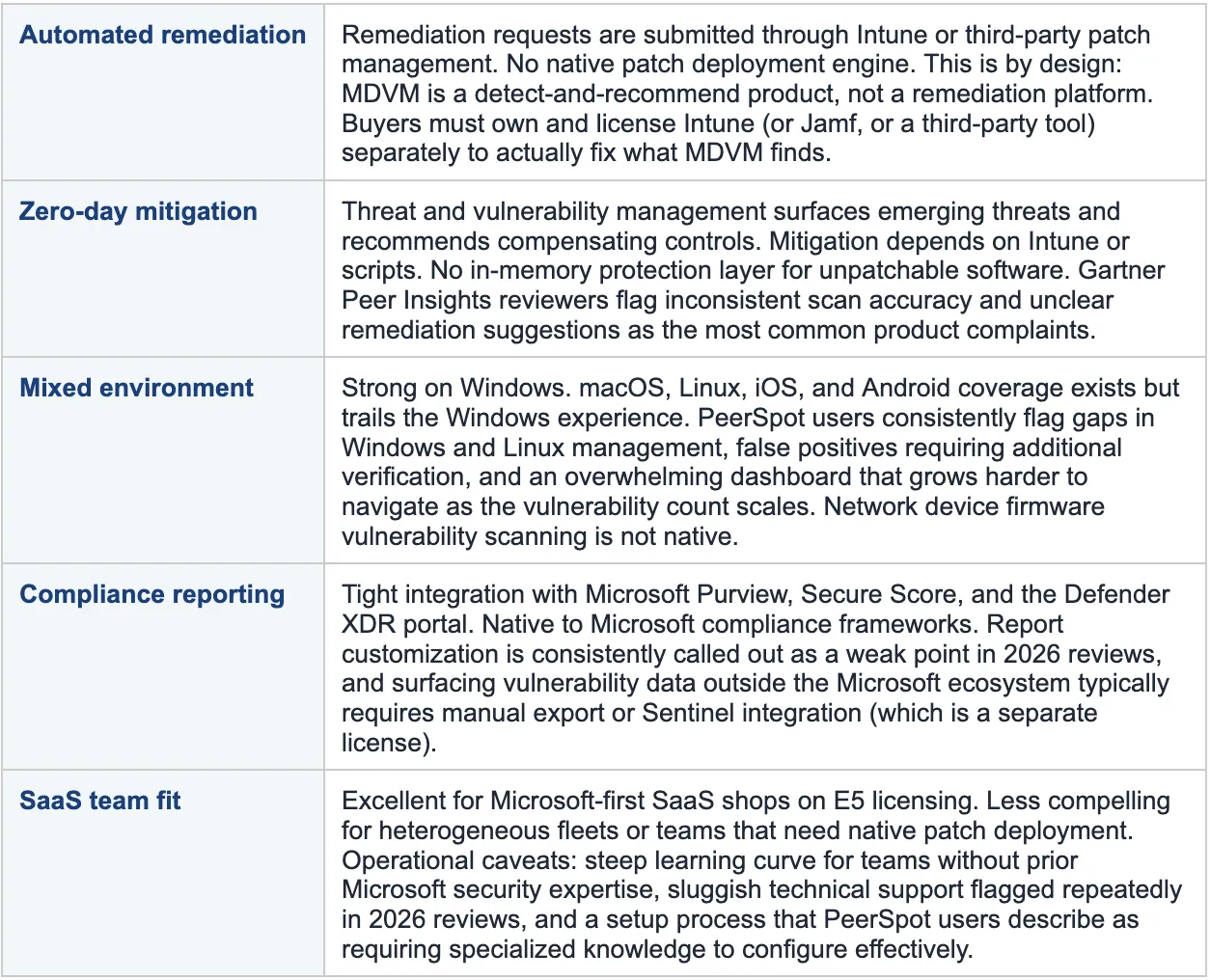
Microsoft Defender Vulnerability Management is the default for SaaS teams already running Microsoft 365 E5 or Defender for Endpoint Plan 2. Detection is agent-based through the Defender for Endpoint sensor, scoring runs through Microsoft's Exposure Score, and remediation requests flow into Microsoft Intune or a connected ITSM tool. For Microsoft-shop SaaS teams, the integration is the entire reason to buy. The licensing math is the catch: MDVM ships inside Defender for Endpoint Plan 2 (E5 or E5 Security add-on at $12 per user per month) but full standalone licensing is a separate SKU. Teams on E3 must upgrade or add-on. Mixed E3 and E5 deployments default to the lower-tier Defender for Business experience unless every user is upgraded.c
The platform's weakness is the same as its strength: it works best inside Microsoft. macOS and Linux coverage exists, third-party application visibility has expanded, but the deeper integration story is Windows plus Intune plus Azure. Mid-market SaaS teams running a mixed Mac and Linux fleet often find themselves bolting on a second tool to fill the gaps. The architectural reality: MDVM detects, but does not deploy patches itself. Remediation requires Intune, ConfigMgr, or a third-party patch tool, which means a Microsoft VM customer is rarely just buying one product. PeerSpot mindshare in the Vulnerability Management category dropped from 3.2% to 2.2% between 2025 and 2026.
How to actually choose between them
The 10 platforms above are not interchangeable. The shortlist for a mid-market SaaS security team usually comes down to three questions, in this order.
Do you need to close the full loop, or just half of it?
If your team has a scanner you trust and you only need the remediation half, Automox or Action1 are honest fits. If you want one platform that scans, scores, prioritizes, fixes, and validates, the shortlist is Vicarius, Qualys TruRisk, Tenable One, or Rapid7 Exposure Command. NinjaOne and Ivanti Neurons also belong here if endpoint management is part of the same buying motion.
How important are remediation options?
If your environment includes legacy software, unpatchable vendor apps, or air-gapped systems where patching is operationally hard, in-memory protection becomes a decision criterion in its own right. Vicarius is the only platform on this list that ships native in-memory protection through vShield. Qualys TruRisk Eliminate and Rapid7's compensating controls assessment are credible alternatives at the script and configuration layer, but they are not the same control.
Where will the budget actually come from?
Asset-based licensing (Tenable, Qualys) is predictable until your asset count balloons. Per-device licensing (Automox, NinjaOne, Ivanti) scales linearly with growth. Microsoft Defender VM is effectively free if you are already on E5. Action1 is free up to 200 endpoints. Vicarius and ManageEngine sit in the middle with negotiable, mid-market-friendly pricing models. Talk to procurement before you shortlist, not after.
Final thought
The consolidation trend is real, and 2026 is the year mid-market SaaS teams stop pretending a scanner alone is a vulnerability management program. The platforms that win this category are the ones that treat detection and remediation as one workflow, scale to mixed environments, produce evidence auditors actually accept, and do not require an SRE to operate.
If your shortlist has more than three names on it, you have not narrowed enough. Pick the closing-the-loop question, the patchless protection question, and the budget question, and the right two or three candidates will be obvious.







































.webp)















%20Signals%20a%20New%20Era%20of%20Supply%20Chain%20Risk.webp)