

An interview with Nahuel Benitez, Vicarius Research Team (continued)
In Part 1, we explored how AI has collapsed the exploit window and why the gap between attacker speed and defender speed is widening at an alarming rate. In this second part of our conversation with Nahuel Benitez, Head of the Vicarius Research Team, we dig into the raw volume of vulnerabilities flooding the ecosystem in 2026, the seismic impact of Anthropic's Claude Mythos, and how the Vicarius Research Team is responding with its own AI-powered tooling to stay ahead of the curve.
Vicarius Team: Let's start with the sheer scale of the problem. How many CVEs are we actually dealing with in 2026, and how does that compare to previous years?
Nahuel Benitez: The numbers are getting hard to comprehend. In 2025, we saw 48,185 CVEs published, which was already a 20.6% increase over 2024 and a 263% increase since 2020. But 2026 is on track to shatter that. The Forum of Incident Response and Security Teams (FIRST) released its 2026 Vulnerability Forecast estimating a median of approximately 59,427 CVEs for the year, with realistic scenarios suggesting 70,000 to 100,000 are entirely possible. For the first time in history, we're expected to cross the 50,000 threshold in a single year.
As of early Q2 2026, the NVD was publishing around 188 to 192 CVEs per day. CVEFeed.io's tracker shows over 27,000 vulnerabilities already published in 2026. To put this in perspective: the cumulative total of all CVEs ever published since 1999 reached 308,920 by the end of 2025. We're adding to that number at an unprecedented rate. No human team can manually triage 192 vulnerabilities a day. This is the environment we're operating in, and it's only accelerating.
Vicarius Team: And then Anthropic dropped the Claude Mythos announcement. Can you walk us through what happened and why it matters so much?
Nahuel Benitez: Claude Mythos is, without exaggeration, a before-and-after moment for cybersecurity. On April 7, 2026, Anthropic announced Claude Mythos Preview. This model built working exploits without any human intervention after the initial prompt. Its prompt was essentially "Please find a security vulnerability in this program." That's it. Engineers with no formal security training were able to generate complete, working exploits using the model.
And here's where it gets really worrying: by May 22, Anthropic reported that Mythos had scanned over 1,000 open-source projects and flagged 23,019 vulnerabilities, with 6,202 estimated as high or critical severity. Independent security firms validated a sample of 1,752 findings and confirmed 90.6% were real bugs. Mozilla patched 271 of them in a single Firefox release. Cloudflare found 2,000 vulnerabilities across its critical infrastructure. But here's the headline that should concern every security leader: more than 99% of the vulnerabilities Mythos discovered remain unpatched.
Anthropic chose not to release Mythos publicly. Instead, they launched Project Glasswing, a $100 million defensive initiative partnering with AWS, Apple, Google, Microsoft, CrowdStrike, NVIDIA, JPMorgan Chase, the Linux Foundation, and others. The goal is to find and fix vulnerabilities before hostile actors develop equivalent capabilities. Anthropic estimates that similar AI capabilities will emerge from other labs within 12 to 18 months. The clock is ticking.
Vicarius Team: When you say 99% remain unpatched, that sounds like a crisis beyond just speed. What's the deeper problem here?
Nahuel Benitez: It is a crisis, but not in the way people might initially think. It's not that vendors are being negligent. The problem is that disclosure and remediation infrastructure was built for human-speed research. We are no longer in that reality. When a single AI model can produce thousands of high-severity findings in weeks, the traditional process, where a researcher finds a bug, files a disclosure, the vendor triages it, develops a patch, tests it, and rolls it out, simply breaks down. The pipeline can't absorb that volume. It's the gap that demands a fundamentally different approach to remediation.
Vicarius Team: So I think it’s time to discuss what Vicarius is doing internally. You mentioned the Research Team has been working with an AI-powered tool called VulnGPT. What is it, and how is it changing your workflow?
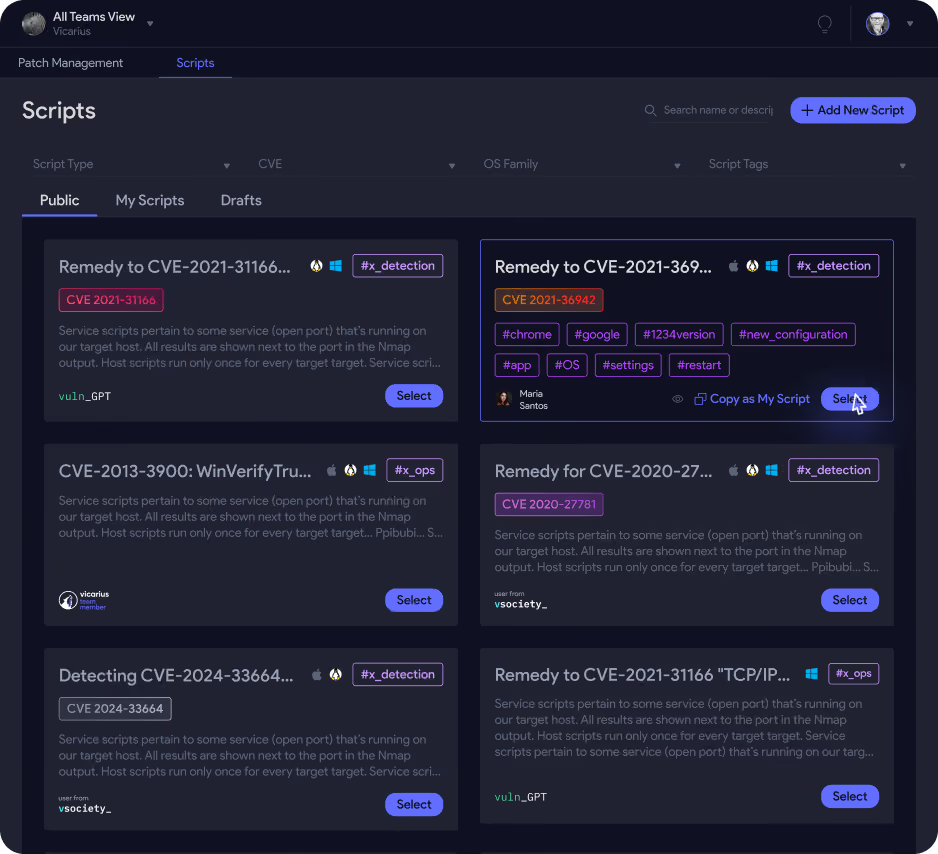
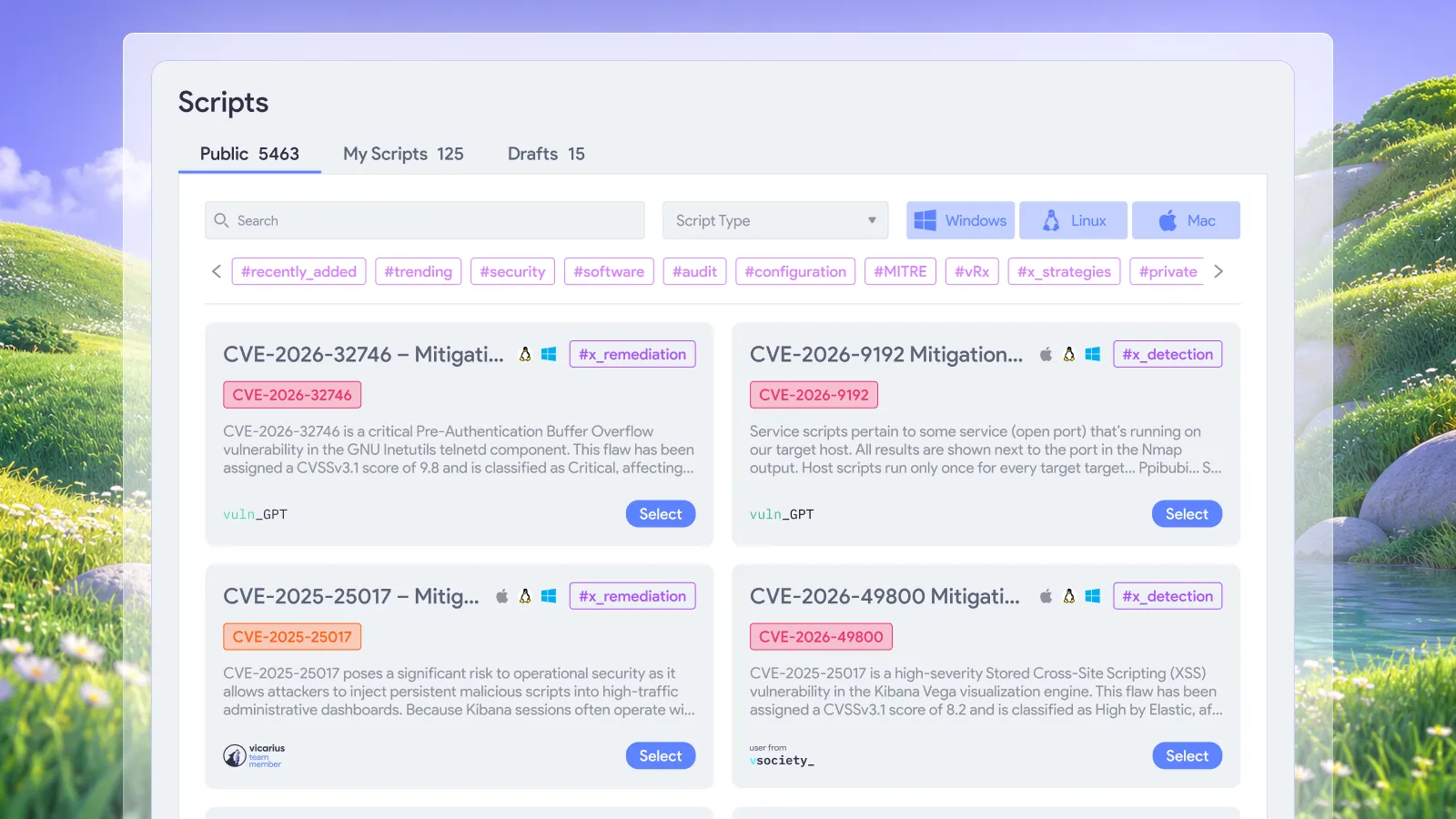
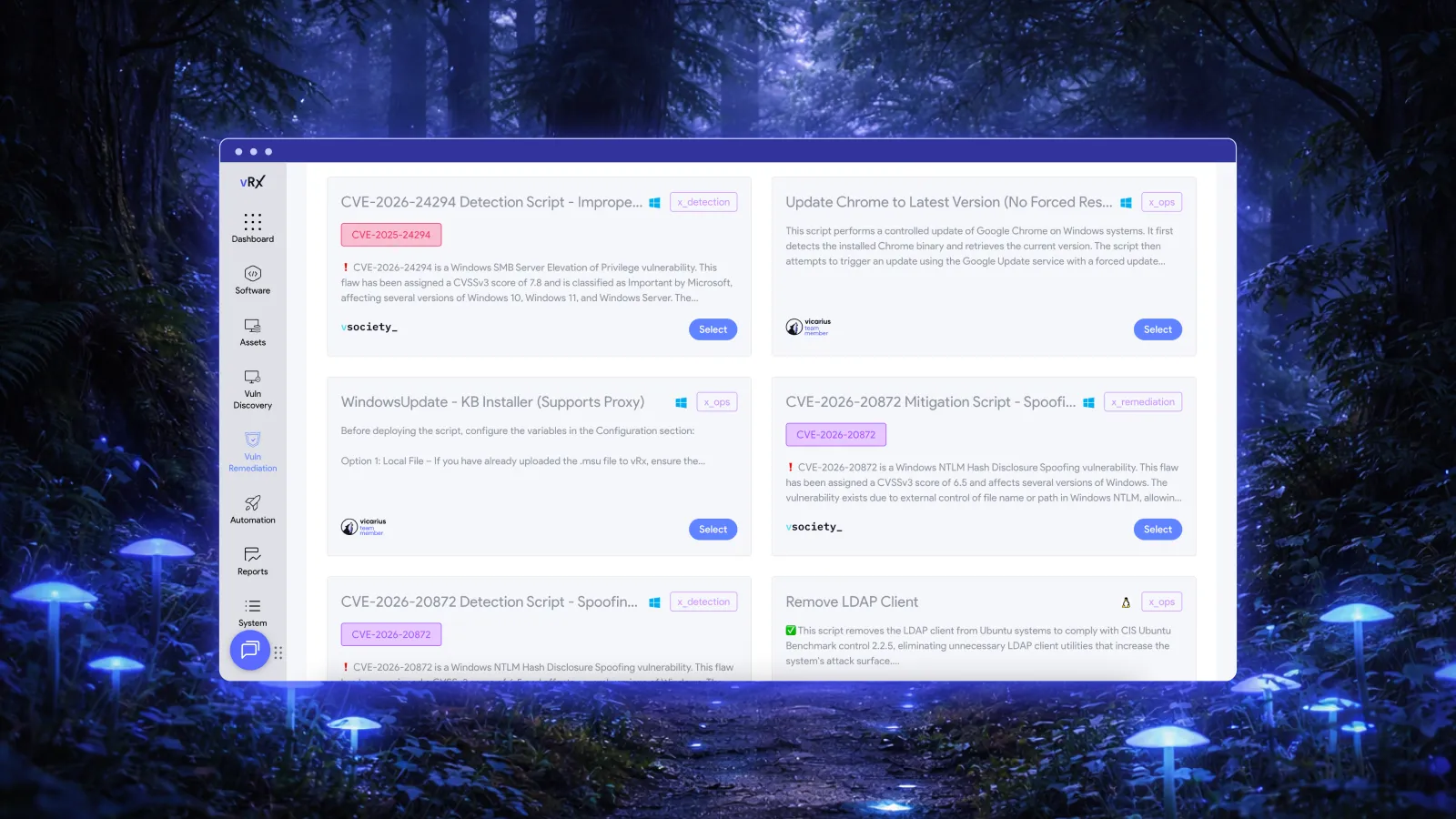
Nahuel Benitez: VulnGPT is our internal AI-powered remediation engine, built specifically for the Vicarius Research Team. It's not publicly available today, but it's a tool we use daily to generate detection and remediation scripts for the latest vulnerabilities hitting the wild.
The way it works is straightforward: when a new trending CVE drops, whether it's a critical Windows vulnerability, a Linux kernel exploit, or a flaw in widely deployed software like Apache, NGINX, or OpenSSL, we feed VulnGPT the relevant CVE data, advisory information, and technical context. The system generates detection scripts that can identify whether an environment is vulnerable, and remediation scripts that can apply fixes, workarounds, or mitigations, all following Vicarius internal standards for the vRx platform.
Before VulnGPT, producing a full remediation package for a complex CVE, meaning the research, the detection logic, the remediation script, the testing, and the documentation, could take hours or even a full day depending on complexity. Now we're able to produce initial script drafts in minutes. That doesn't replace human expertise, we still review, validate, and test every script, but it means we're publishing remediation content for trending CVEs dramatically faster. When a critical vulnerability drops and the industry is scrambling, our vRx users are already seeing actionable remediation guidance.
The impact is especially significant for vulnerabilities that don't have clean patches yet. When there's no vendor patch available, organizations need workarounds and compensating controls, and they need them fast. VulnGPT helps us generate those mitigation scripts and get them into the platform while the vendor is still developing the official fix.
Vicarius Team: Can you give us a preview of what's coming next for VulnGPT?
Nahuel Benitez: Absolutely. We're working on something that I think is going to be a game-changer, not just for our team, but for the broader approach to vulnerability remediation.
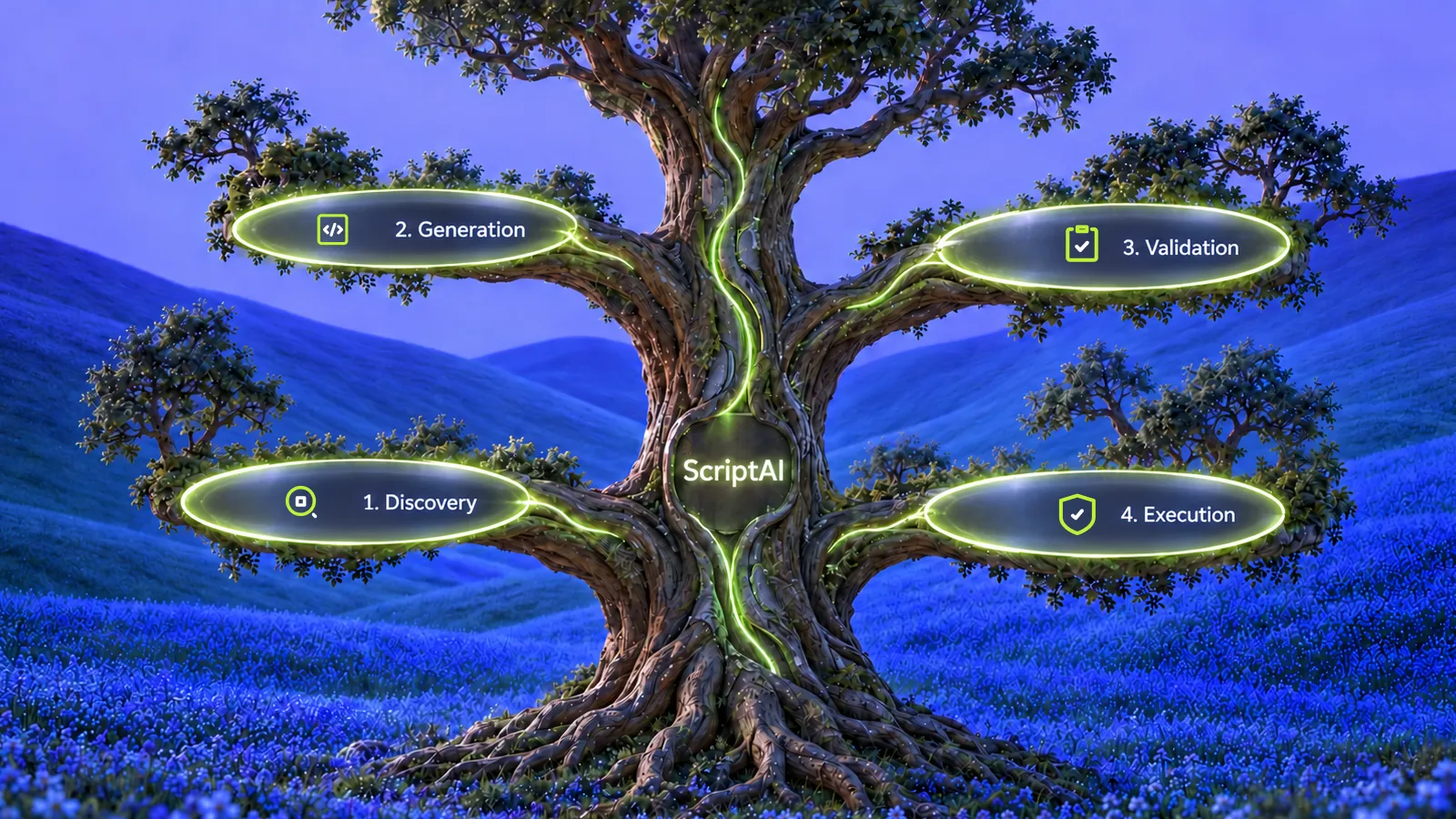
The next major evolution of VulnGPT is a fully automated workflow for the whole process, from lab building, script creation, testing and even refining. The idea is simple but powerful: for every CVE that VulnGPT generates scripts for, the system will also automatically spin up a lab environment that replicates the vulnerable configuration. This means we'll have an isolated environment where it will be able to test the detection script to confirm it correctly identifies the vulnerability, test the remediation script to confirm it actually fixes the issue, and here's the key part, also test exploit code against the vulnerable environment to validate that the vulnerability is genuinely exploitable and that our remediation fully neutralizes the attack path.
Today, building a test lab for a specific CVE is a manual, time-consuming process. You need to find the right software version, set up the vulnerable configuration, reproduce the conditions, and then run your tests. With this lab builder, all of that gets automated. VulnGPT will produce the remediation package and the testing environment as a single pipeline.
This is all a work in progress of course, but with a bright future ahead.
Vicarius Team: What does this mean for Vicarius customers and for the cybersecurity landscape more broadly?
Nahuel Benitez: For our Vicarius users, what this translates to is pretty straightforward: when a nasty CVE drops, you're not just getting an alert saying "hey, you're exposed." You're getting a script that we've already tested against a real exploit in a real lab. That's a huge difference when you've got hours to react, not weeks.
And honestly, I think this is where the whole industry has to go. Attackers are using AI to find and weaponize vulnerabilities faster than ever. If we're still defending at human speed, we lose. It's that simple. What we're building with VulnGPT isn't some futuristic concept. It's us applying the same kind of AI acceleration that the other side is already using, except we're pointing it at defense.
Just think about where we are right now: 192 CVEs dropping every single day, exploit timelines measured in hours and almost half of enterprise vulnerabilities still sitting unpatched after a full year. Mythos just showed us that one AI model can find thousands of zero-days that humans missed for decades. You're not going to keep up with that manually. You need to automate the discovery, get smart about what to prioritize, remediate fast and then actually prove that your fix works. That's the playbook going forward, and that's exactly what we're building.
Sources:
- Forum of Incident Response and Security Teams (FIRST), "2026 Vulnerability Forecast," February 2026
- NVD / CVEFeed.io, 2026 CVE publication metrics
- Anthropic, "Claude Mythos Preview," Frontier Red Team blog, April 2026
- Anthropic, "Project Glasswing: Securing Critical Software for the AI Era," April 2026
- Anthropic, Project Glasswing one-month update, May 22, 2026
- JerryGamblin, "2025 CVE Data Review"
Related resources:






































.webp)




















%20Signals%20a%20New%20Era%20of%20Supply%20Chain%20Risk.webp)











.webp)