

How it works and when it should be used
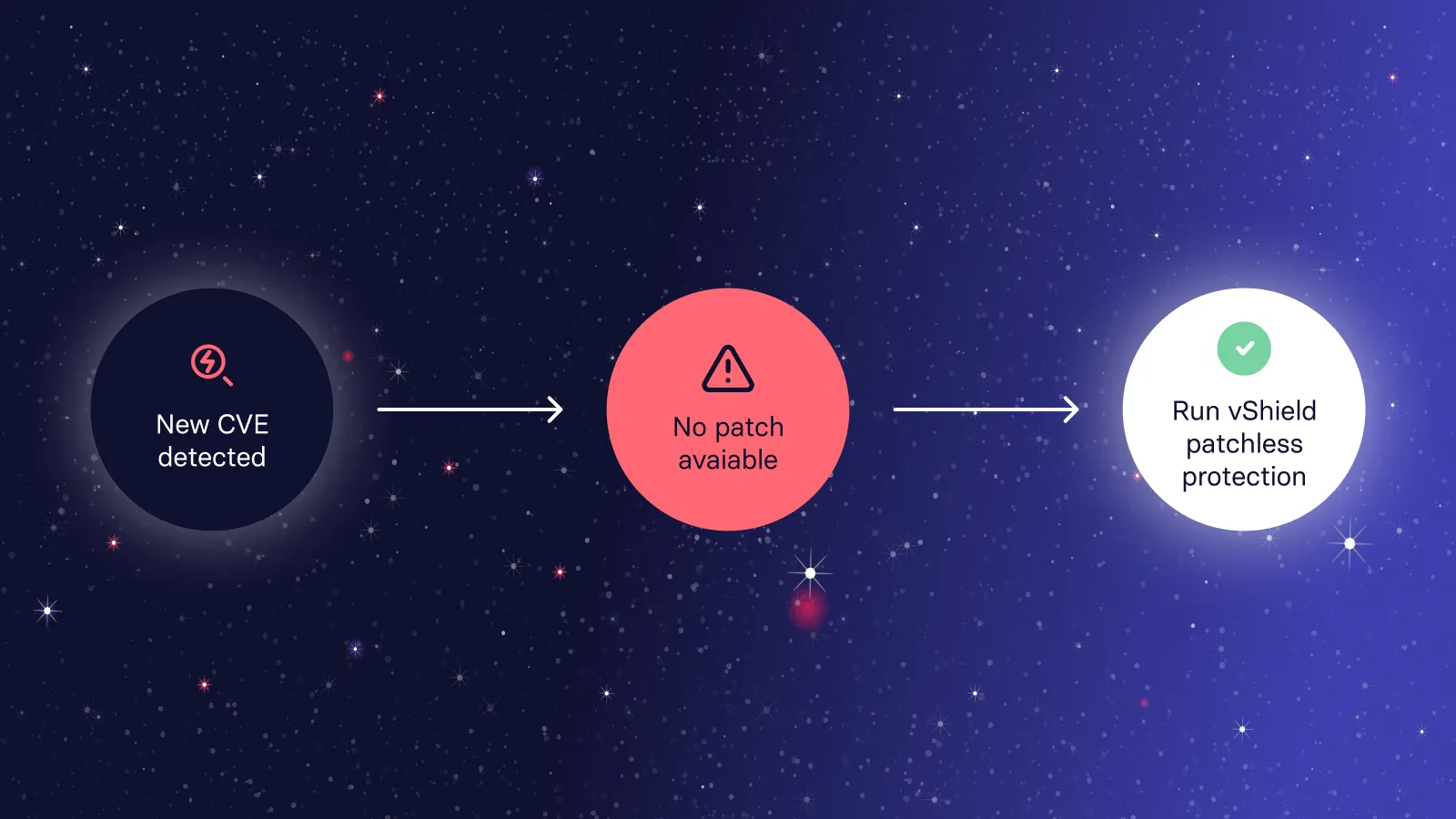
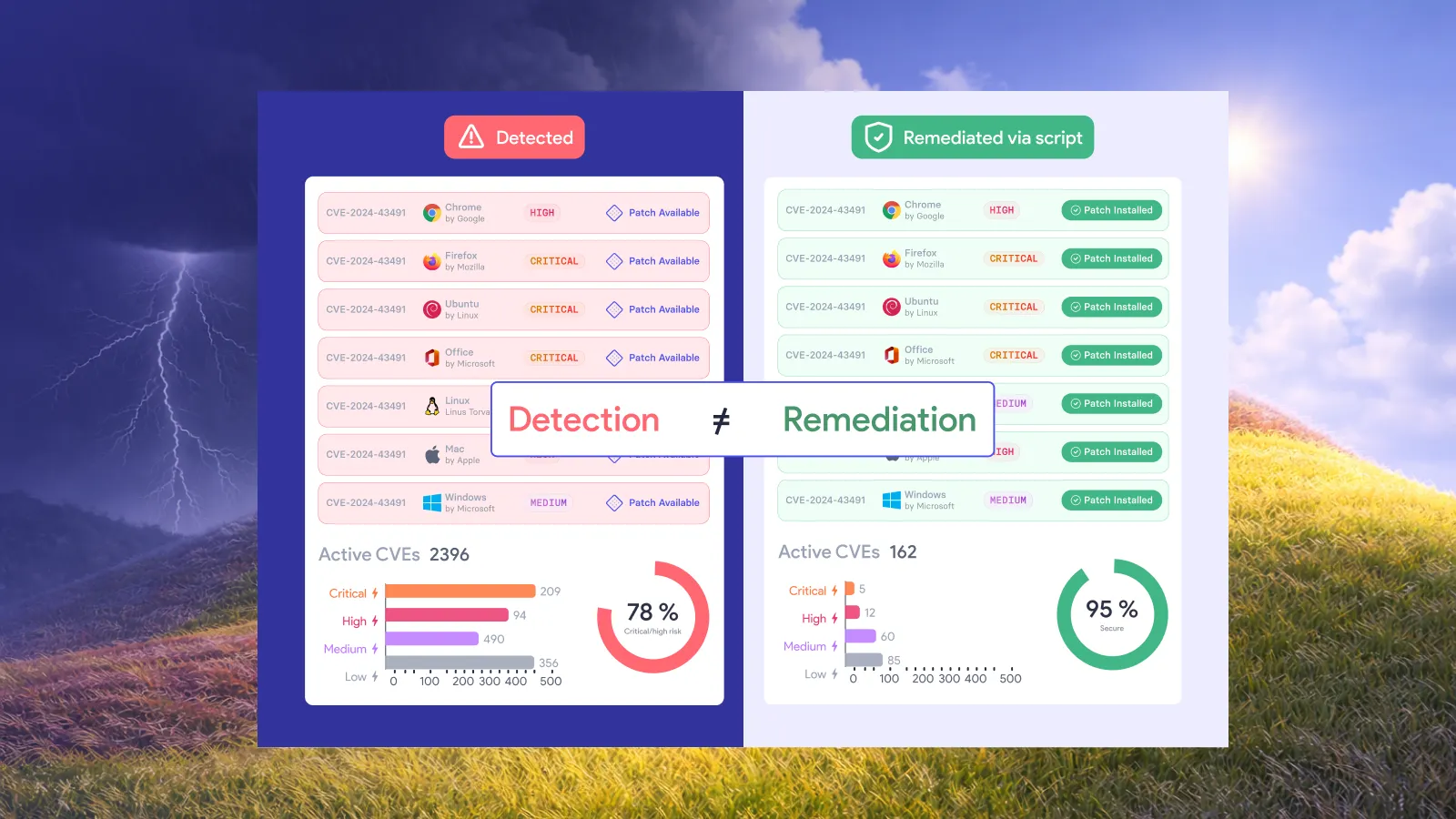
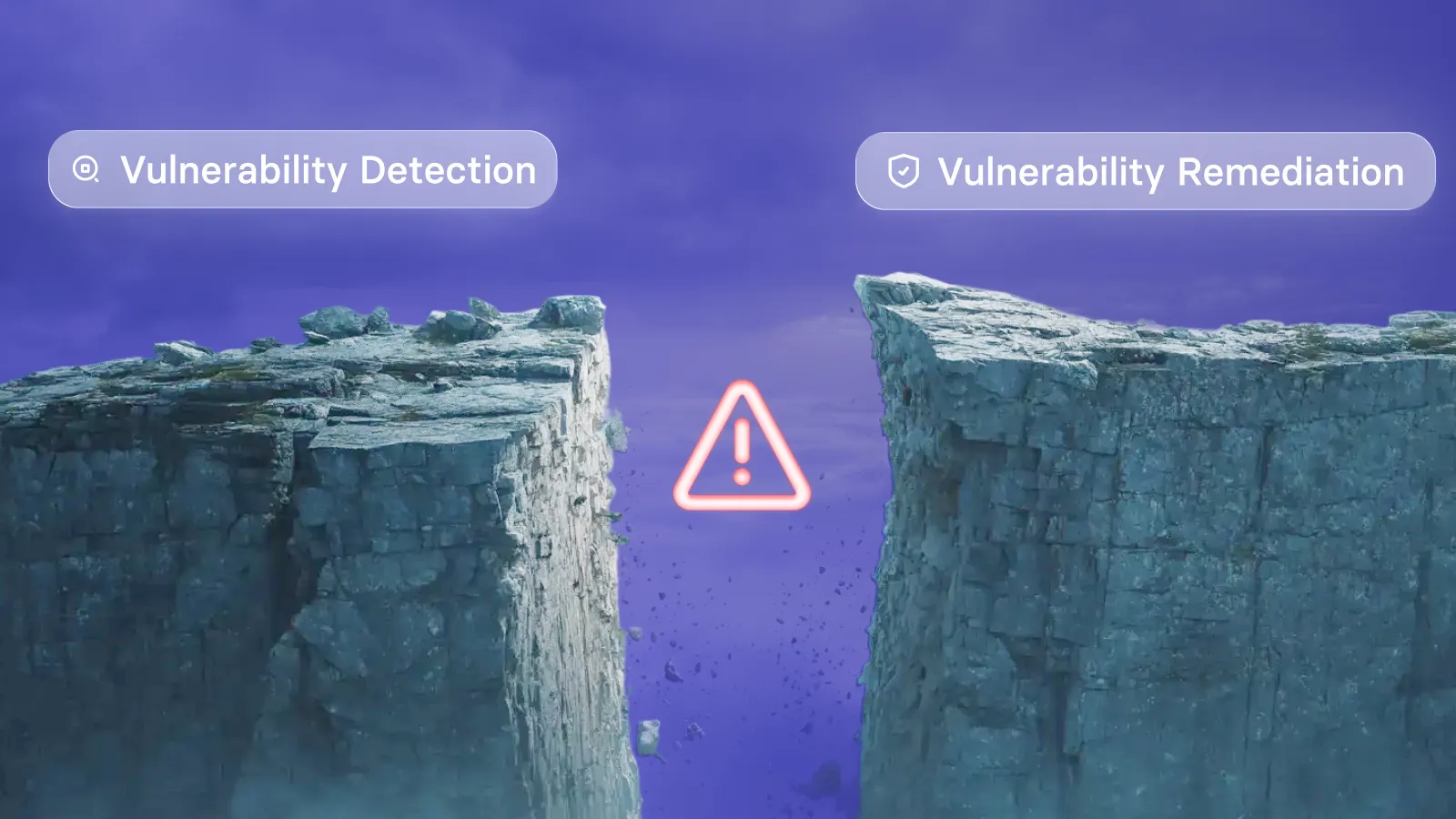
There is a window between when a vulnerability is disclosed and when a patch ships, is tested, is approved by change management, and finally lands in production. That window used to be measured in months. Now it is measured in days.
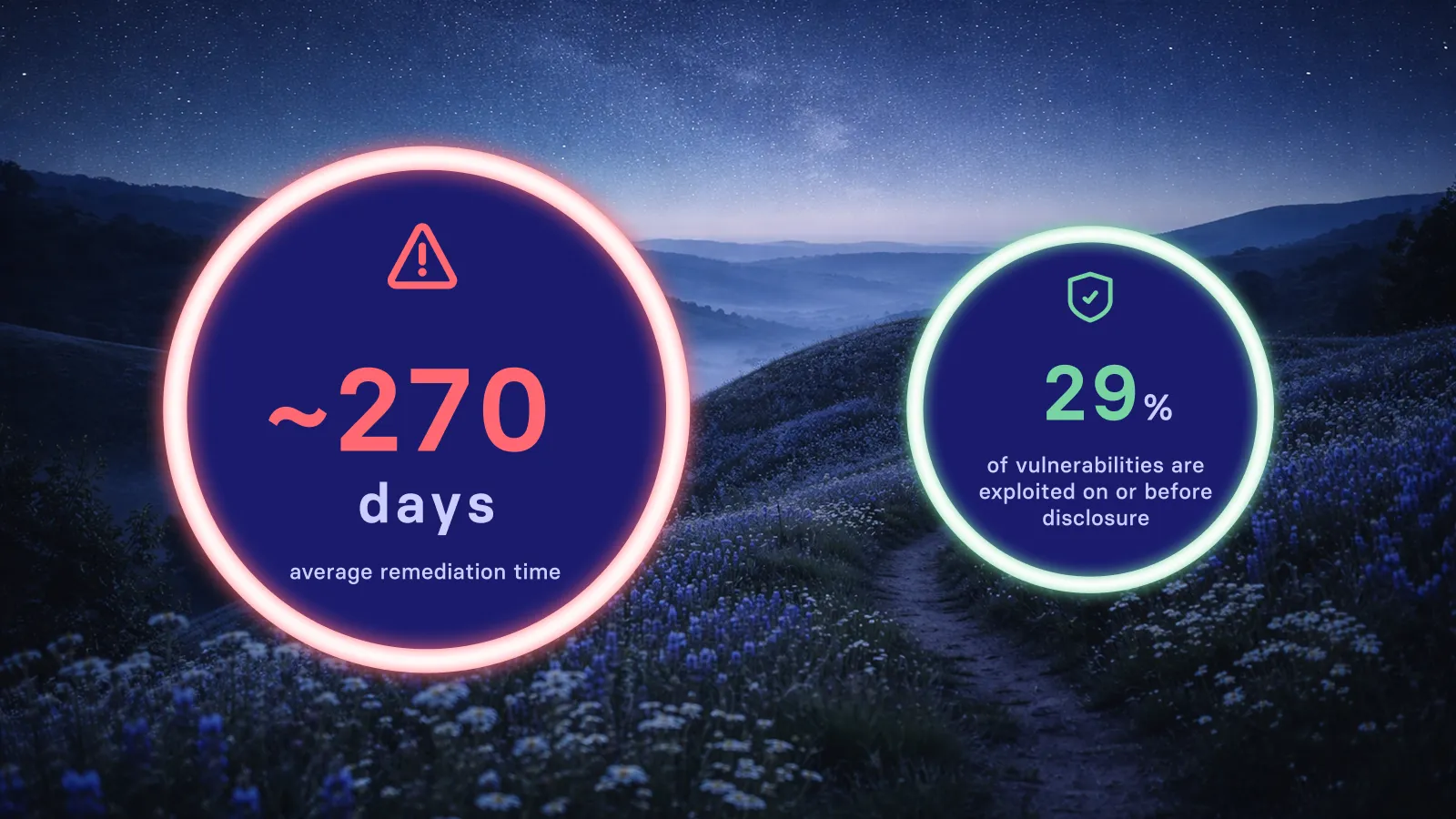
According to VulnCheck's full-year 2025 exploitation analysis, 28.96% of known exploited vulnerabilities were first exploited on or before their CVE publication date. Mandiant M-Trends puts the median time-to-exploit at under 5 days. Edgescan's 2025 Vulnerability Statistics Report puts the average mean time to remediate a critical vulnerability at 74.3 days. That is not a gap. That is structural exposure.
Patching fixes the underlying flaw. It remains the right long-term answer. But patching takes time, and time is what attackers exploit.
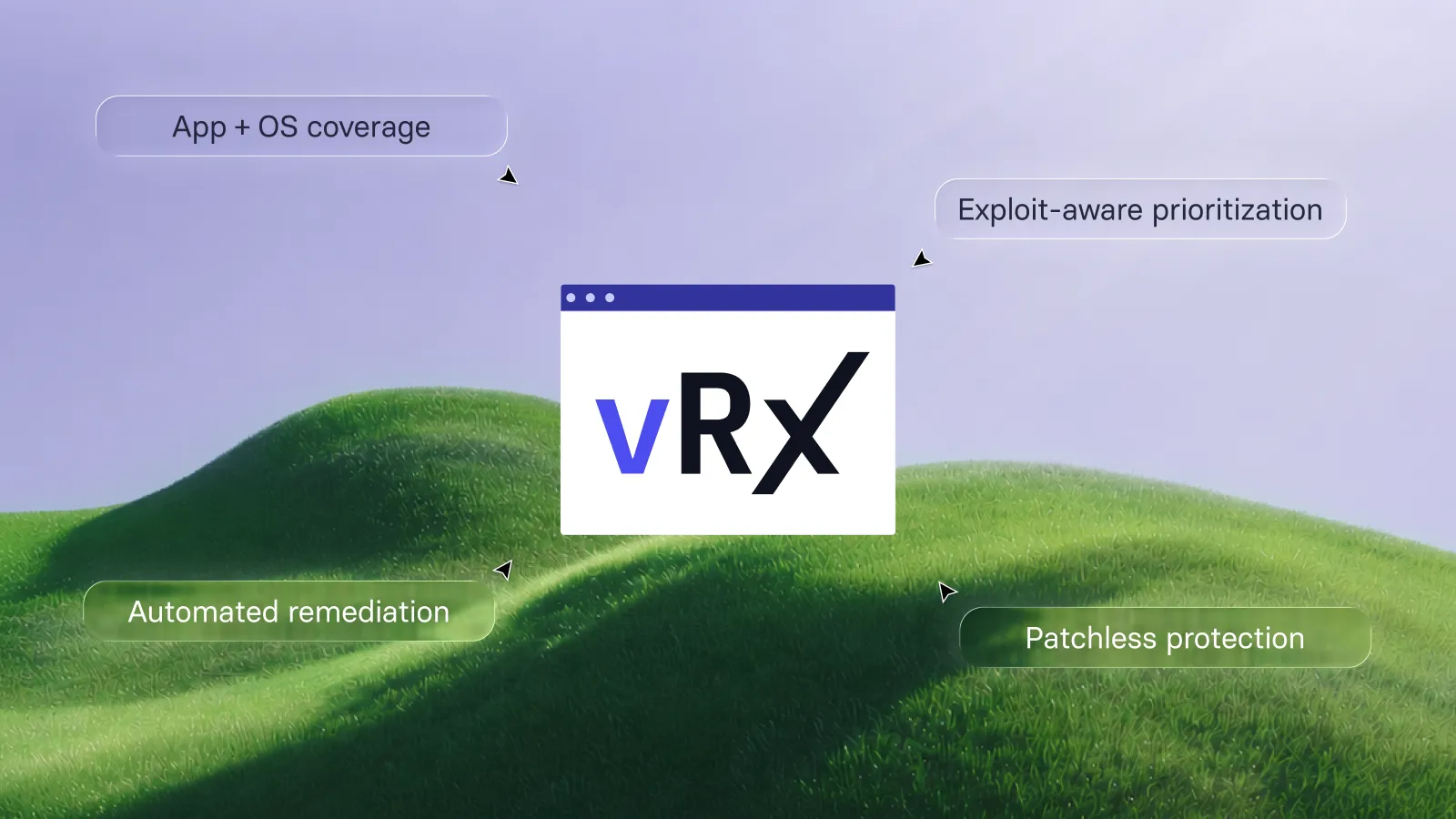
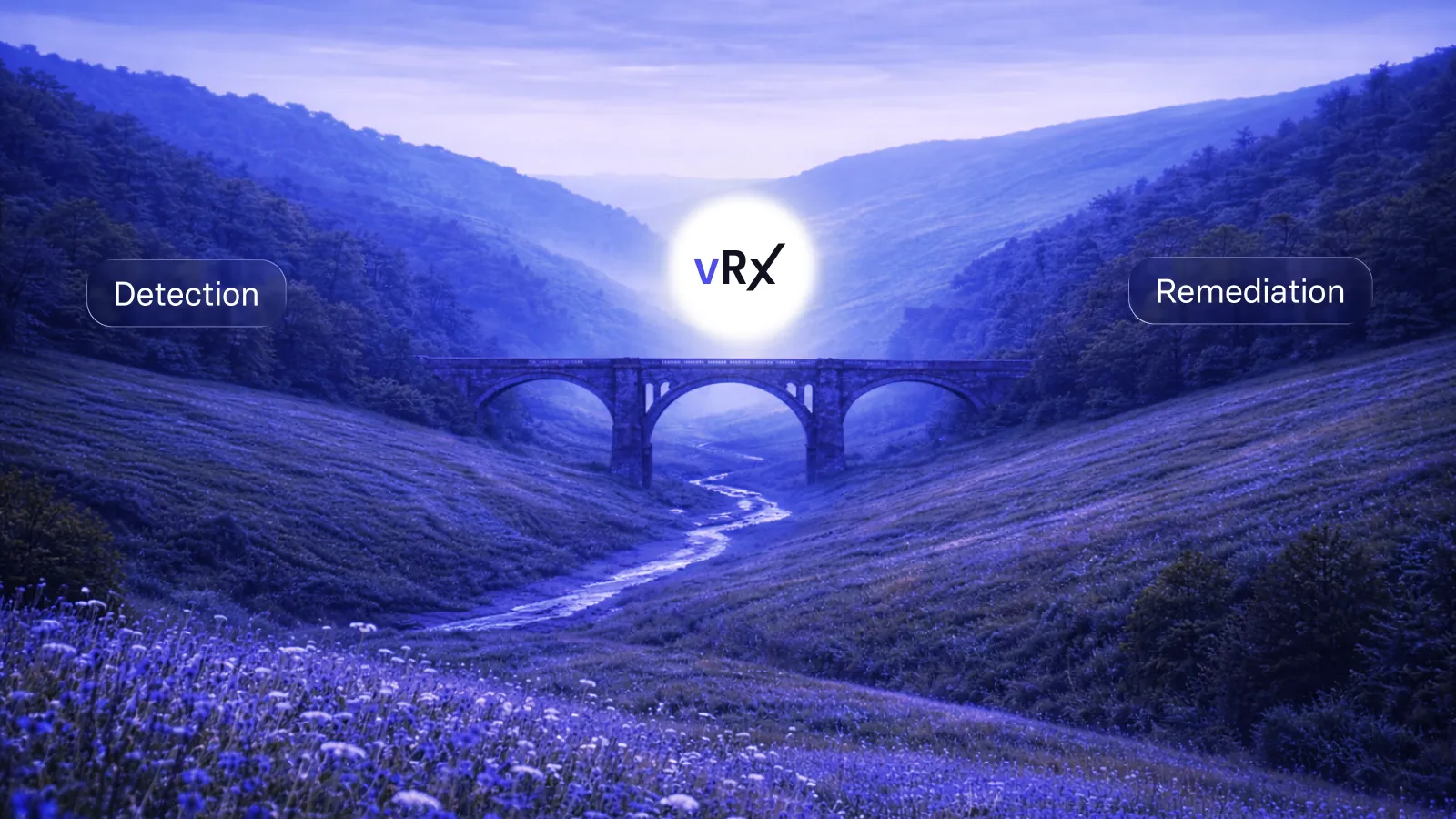
Patchless protection is designed to cover that window. This post explains the technology behind it specifically how vRx implements it and the operational scenarios where it matters most.
What patchless protection actually means
Patchless protection is not a firewall rule. It is not a WAF policy or a network-layer filter. It operates at the process level, inside the memory space of a running application, intercepting exploitation attempts before they reach vulnerable code.
The term "virtual patching" describes the same concept from a different angle, rather than modifying the application binary to remove the vulnerability, you create a protective layer around the vulnerable code that neutralizes attempts to exploit it.
vRx refers to this capability internally as vShield. It is a proprietary in-house technology, not a repackaged open-source tool.
The core mechanism is dynamic binary instrumentation (DBI), a technique that instruments application code at runtime without modifying the binary on disk. Understanding DBI is the key to understanding why this works.
Dynamic binary instrumentation: the engine underneath
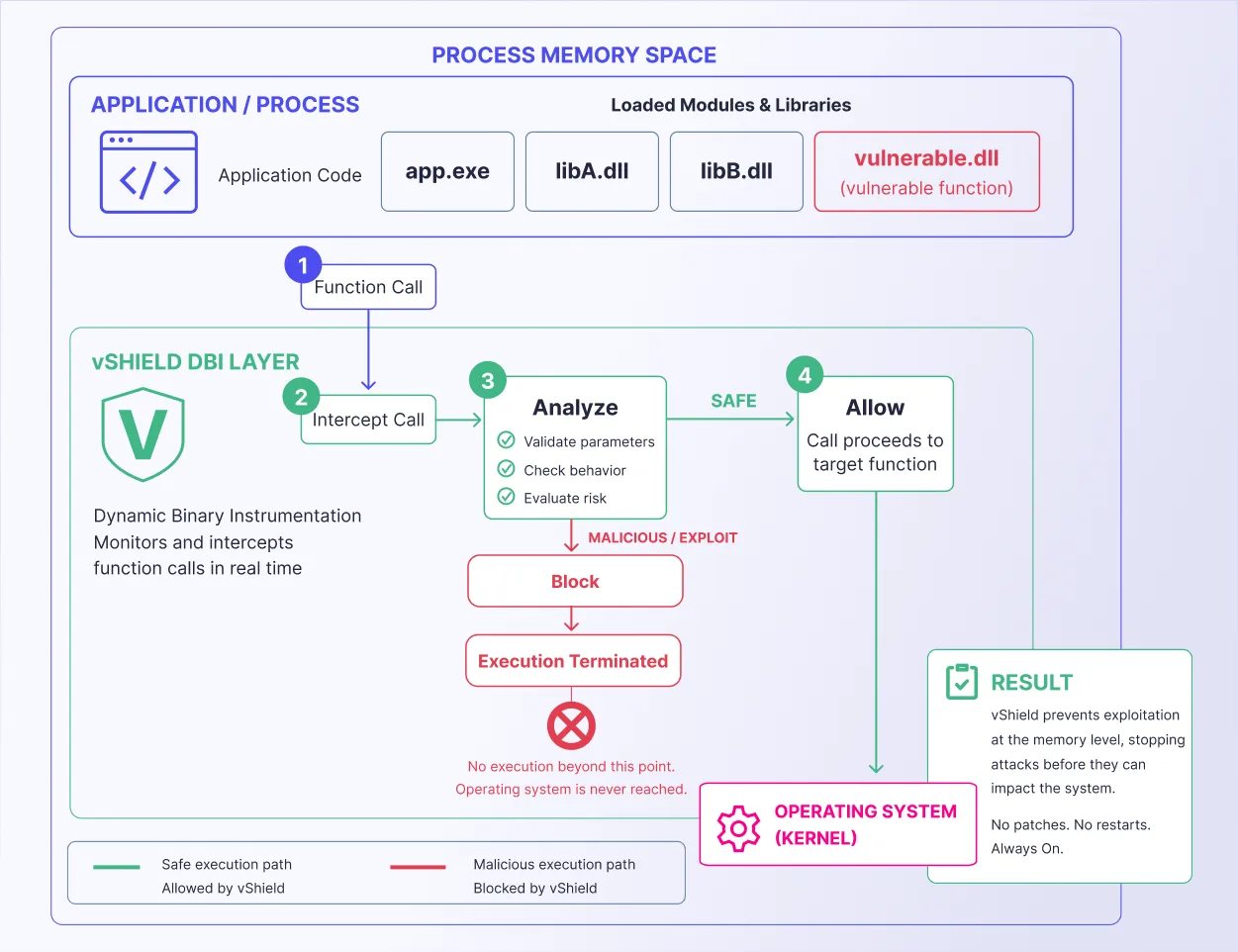
DBI frameworks operate in user mode. When an application is launched or when the instrumentation layer is attached to a running process the DBI engine takes control of execution before the application's own code runs. It begins by copying the application's native code, basic block by basic block, into a separate region of memory called the code cache. All execution then runs through the code cache rather than the original code pages.
This matters for security because at the point of copying, the DBI engine can inject analysis code, callbacks, or blocking logic around specific instructions or function calls. The application never knows this is happening. From the application's perspective, it is running normally.
For patchless protection, vRx uses DBI to identify and hook the specific functions known to be vulnerable to the ones named in a CVE. When the vulnerable function is invoked, the DBI engine's injected callback fires first. That callback can:
- Inspect the call context: checking arguments, stack state, and caller identity for signs of exploitation
- Allow or deny the call: passing clean calls through transparently, blocking calls that match exploitation patterns
- Alert the administrator: logging the event without blocking, for monitoring mode deployments
This happens in memory, at runtime, without touching the application binary on disk and without requiring a system restart.
How vRx implements it: the two protection layers
vRx's patchless protection operates on two distinct levels simultaneously.
Layer 1: Memory space isolation
The first layer wraps the entire process address space of the vulnerable application. It limits which external processes and system calls can access the memory region where the vulnerable application lives.
Memory injection and scraping attacks techniques attackers use to read sensitive data from a running process or plant malicious shellcode into its address space require the ability to write to or read from that memory region. vRx restricts those access paths by enforcing controls at the OS level that govern what can touch the process's allocated memory pages.
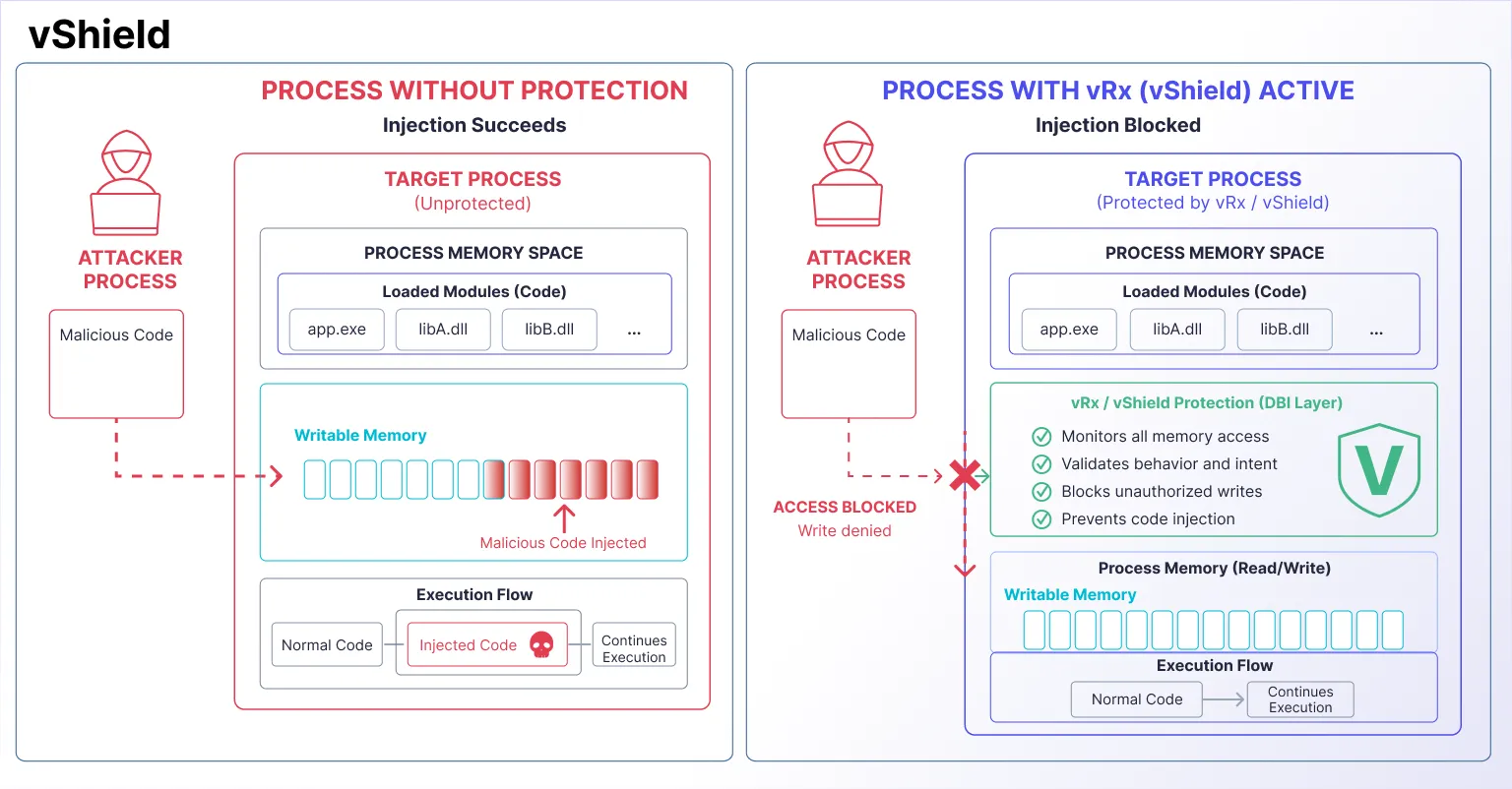
This layer does not inspect the content of calls. It operates as a boundary control, reducing the attack surface by preventing unauthorized cross-process memory interactions before any code execution even occurs.
Layer 2: Function-level in-memory interception
The second layer is where the DBI engine does its most precise work. When vRx applies patchless protection to a specific CVE, it has already analyzed the vulnerability to identify which functions are exploitable and what the exploitation patterns look like.
When the vulnerable application loads into memory, vRx tracks the entry points of those vulnerable functions. It knows their addresses in the process's virtual address space, accounting for address space layout randomization (ASLR).
At each vulnerable entry point, vRx inserts instrumentation code. When execution reaches that point, the callback evaluates the call. A legitimate internal call from the application will look different from an exploit attempt at the function signature level. Arguments that exceed expected bounds, return addresses that point to unexpected memory regions, or call sequences that match known exploit techniques all trigger the protection logic.
For exploit attempts, the vRx agent either:
- Blocks the system call in memory: returning a safe error code to the caller so the application does not crash, while preventing the actual vulnerable operation from executing
- Notifies the administrator in real time: capturing the event with full context for investigation
The mode is configurable. Environments where blocking could cause false positives may run in monitor mode first, observe for a period, then switch to block.
What this looks like for a specific vulnerability class
Consider a memory corruption vulnerability, a buffer overflow or use-after-free in a third-party application. These are among the most common CVE classes. The typical attack flow:
- Attacker sends a crafted input to the application
- The input exceeds the expected buffer size
- The overflow overwrites adjacent memory, including control data like return addresses
- Execution is redirected to attacker-controlled code
With vRx active: At step 2, the DBI instrumentation on the vulnerable function fires. It detects that the input exceeds the safe bounds the vulnerability analysis defined. The call is blocked before the overflow occurs. The application receives a controlled error response. No memory corruption. No code execution. The original binary has not been modified. The application remains fully functional for legitimate operations.
The executable and binary file layer
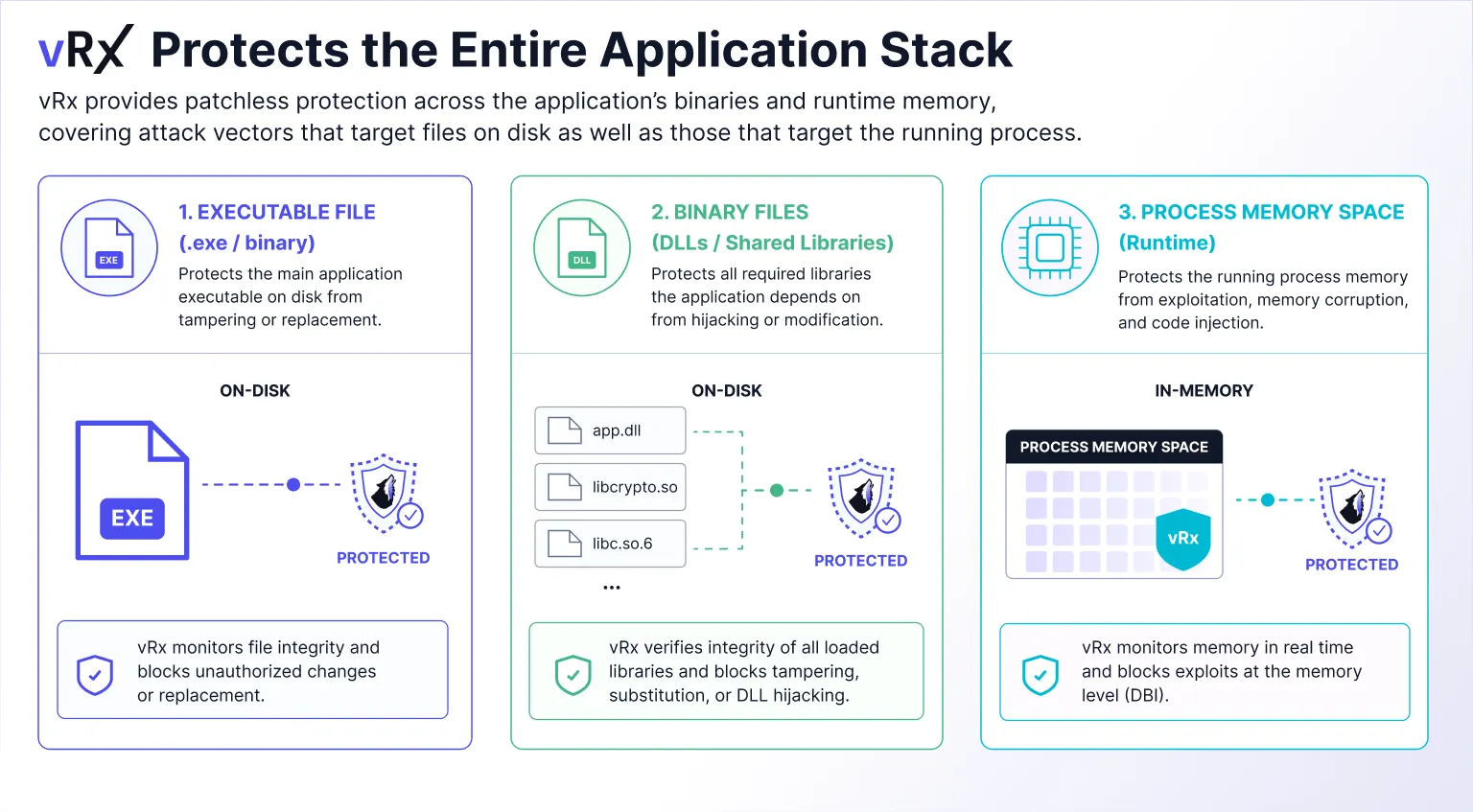
vRx's patchless protection covers more than the running process. It also secures the executable file itself and the binary files it depends on DLLs on Windows.
Why does this matter? Some attack vectors target the on-disk binary rather than the running process. DLL hijacking, for example, replaces or intercepts a shared library that a target application loads. If the application loads the attacker-controlled DLL, the malicious code runs in the application's process context with its permissions.
vRx monitors the integrity of the protected application's binaries and the libraries it loads. Unauthorized modifications to those files or substitution of those files with malicious versions trigger alerts and can block the affected load operation.
This extends the protection model from purely runtime to a combination of runtime and pre-load integrity.
What vRx does when a patch becomes available
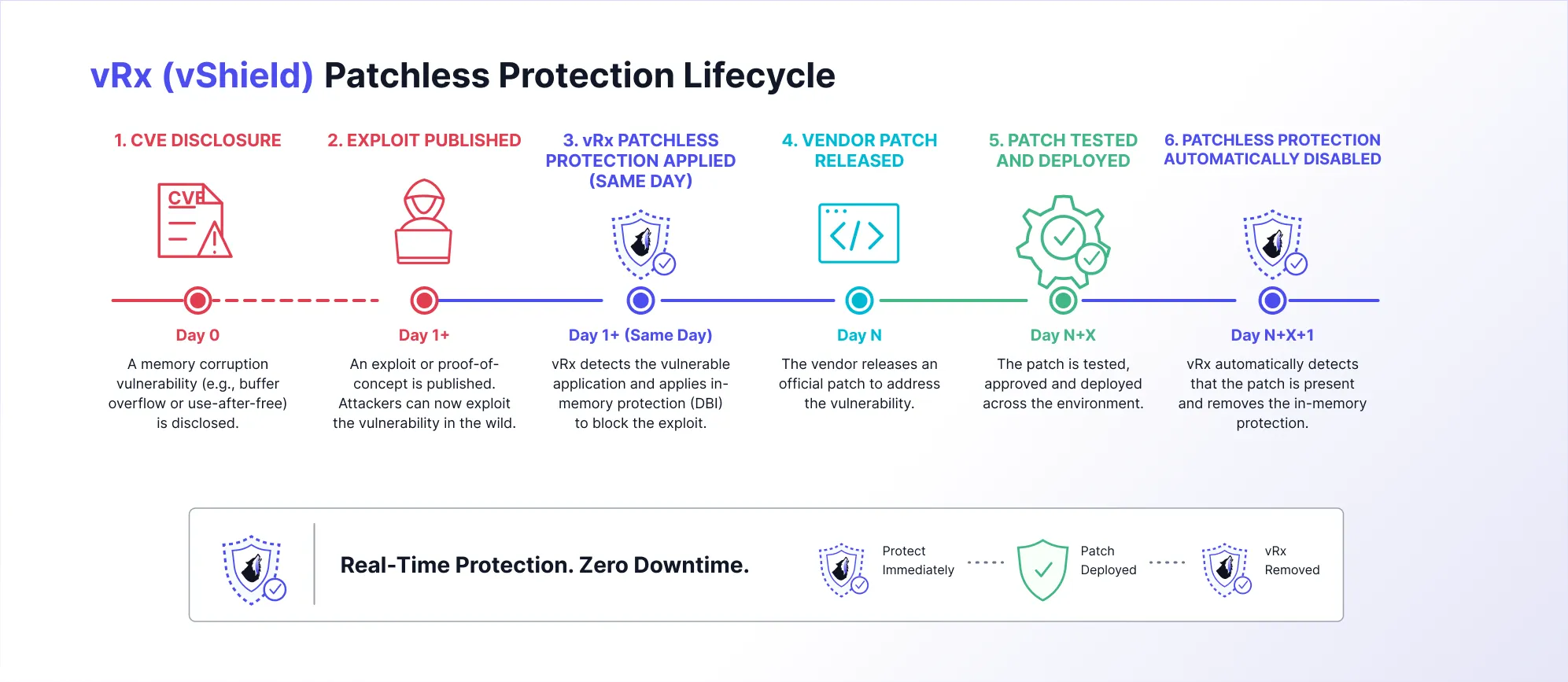
Patchless protection is a compensating control, not a permanent replacement for patching. vRx is built around this distinction.
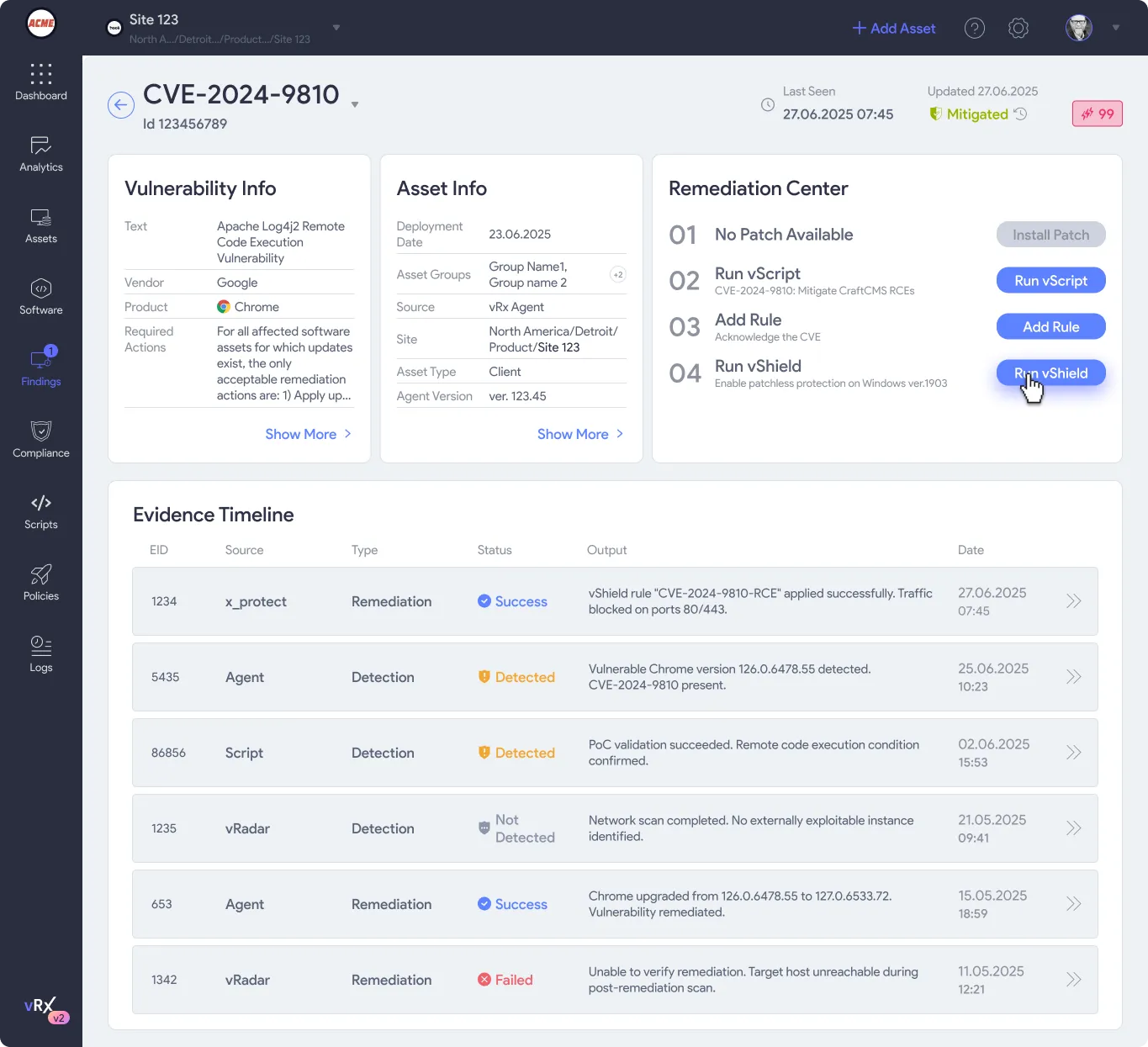
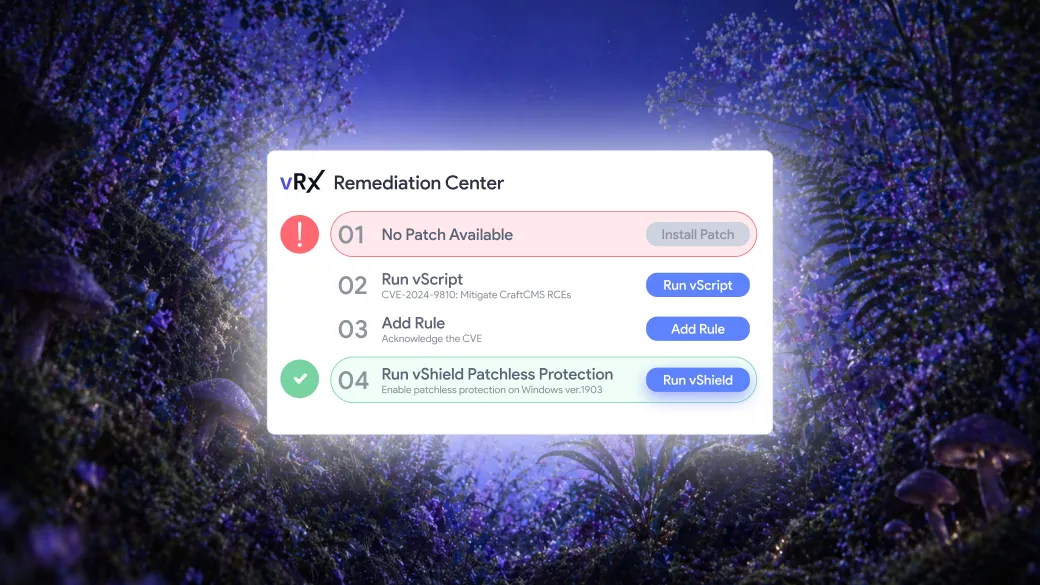
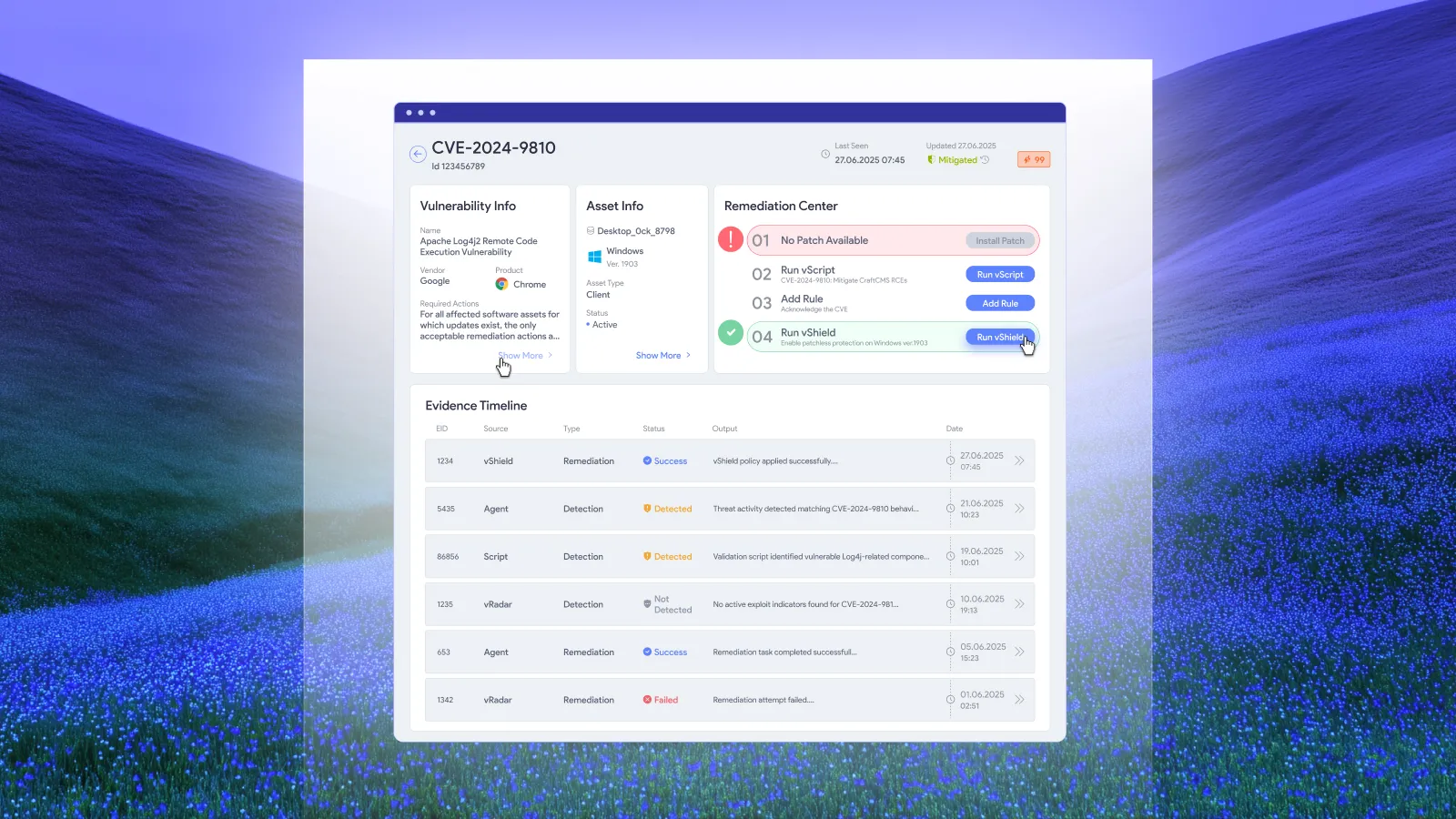
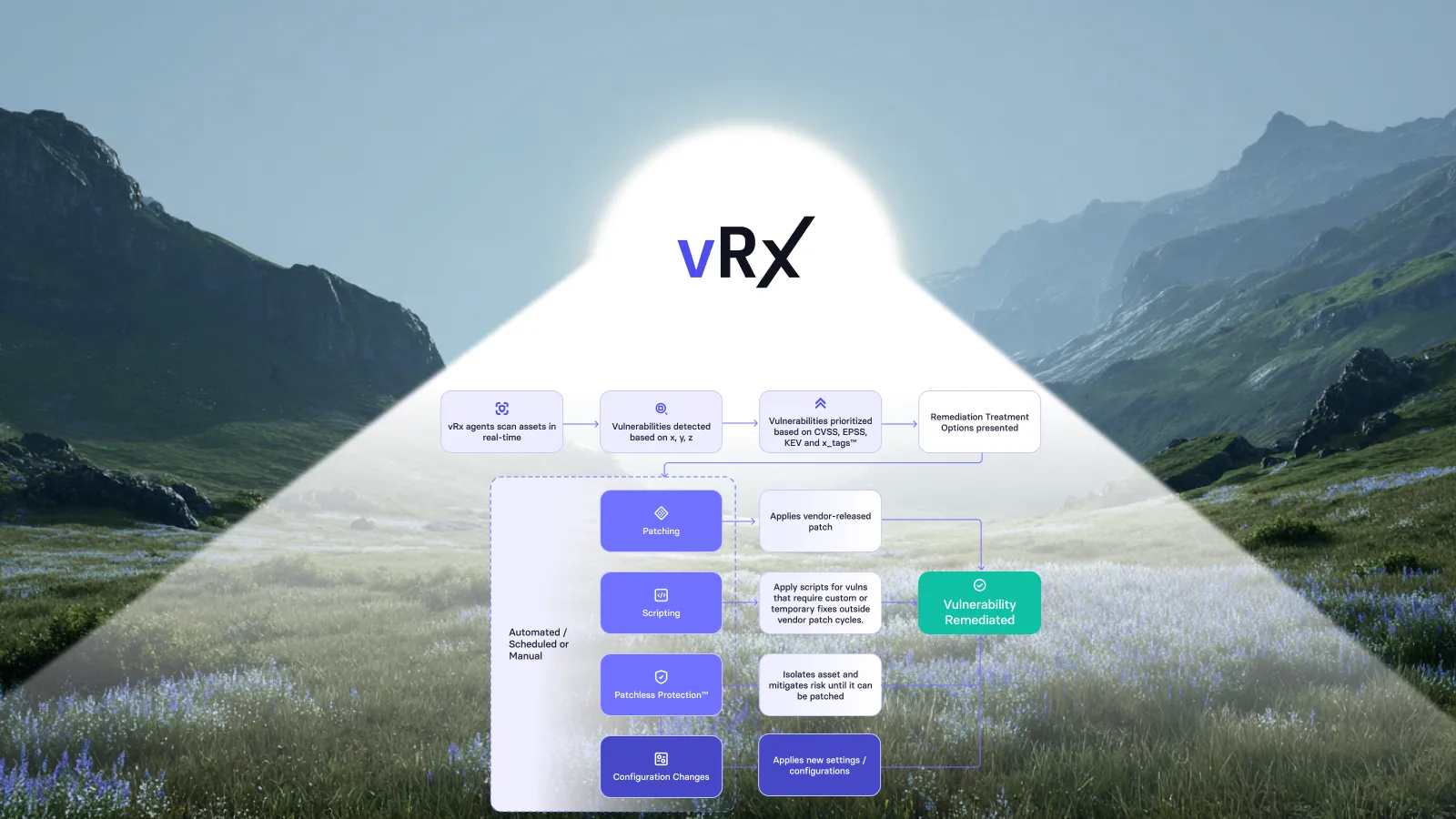
When a vendor releases a validated patch for a CVE that vRx has been protecting against, and you deploy that patch through vRx's automated patching engine, the platform automatically disables the patchless protection for that specific CVE on the patched assets. You do not have to manually track which protections are still needed.
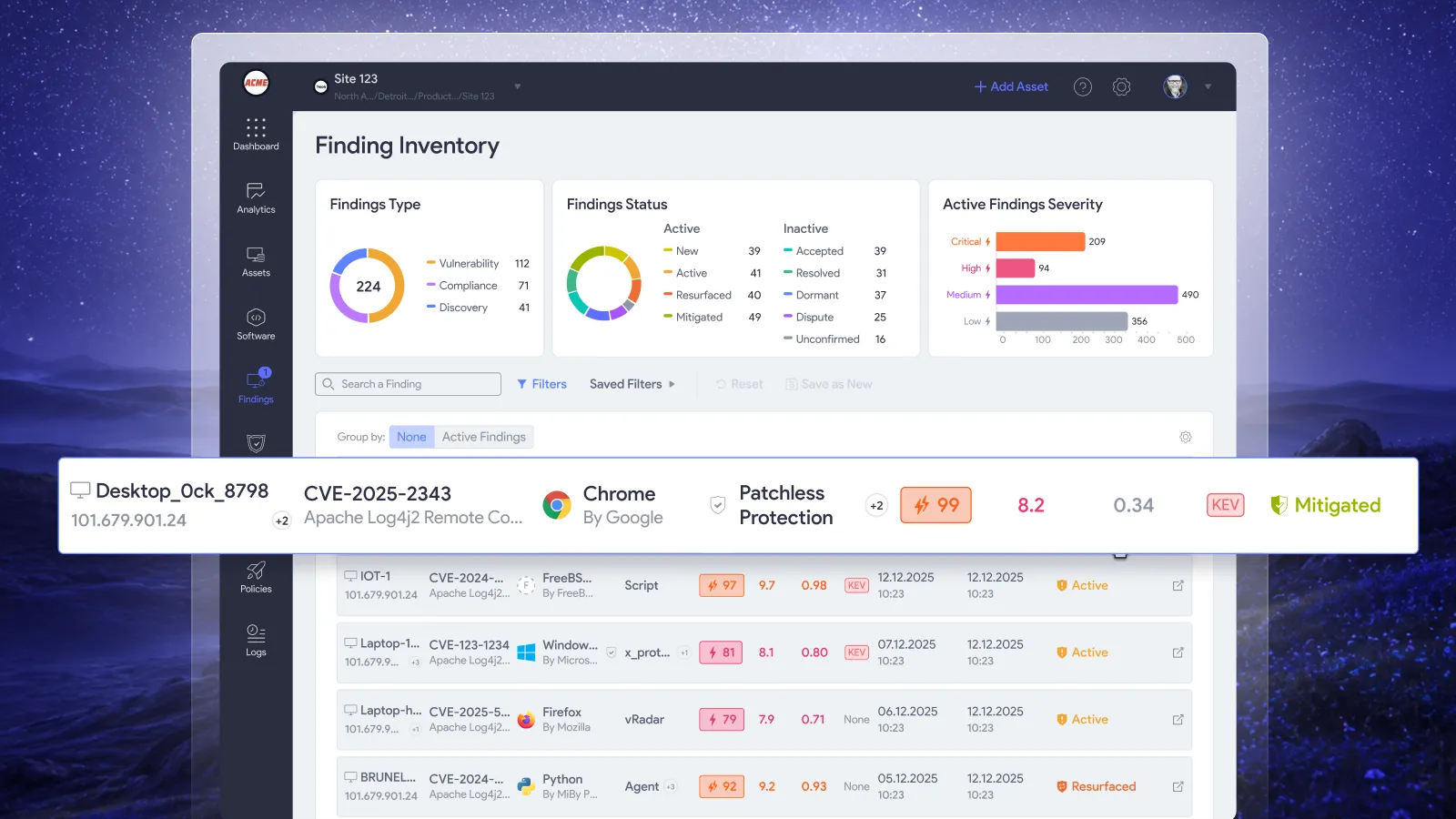
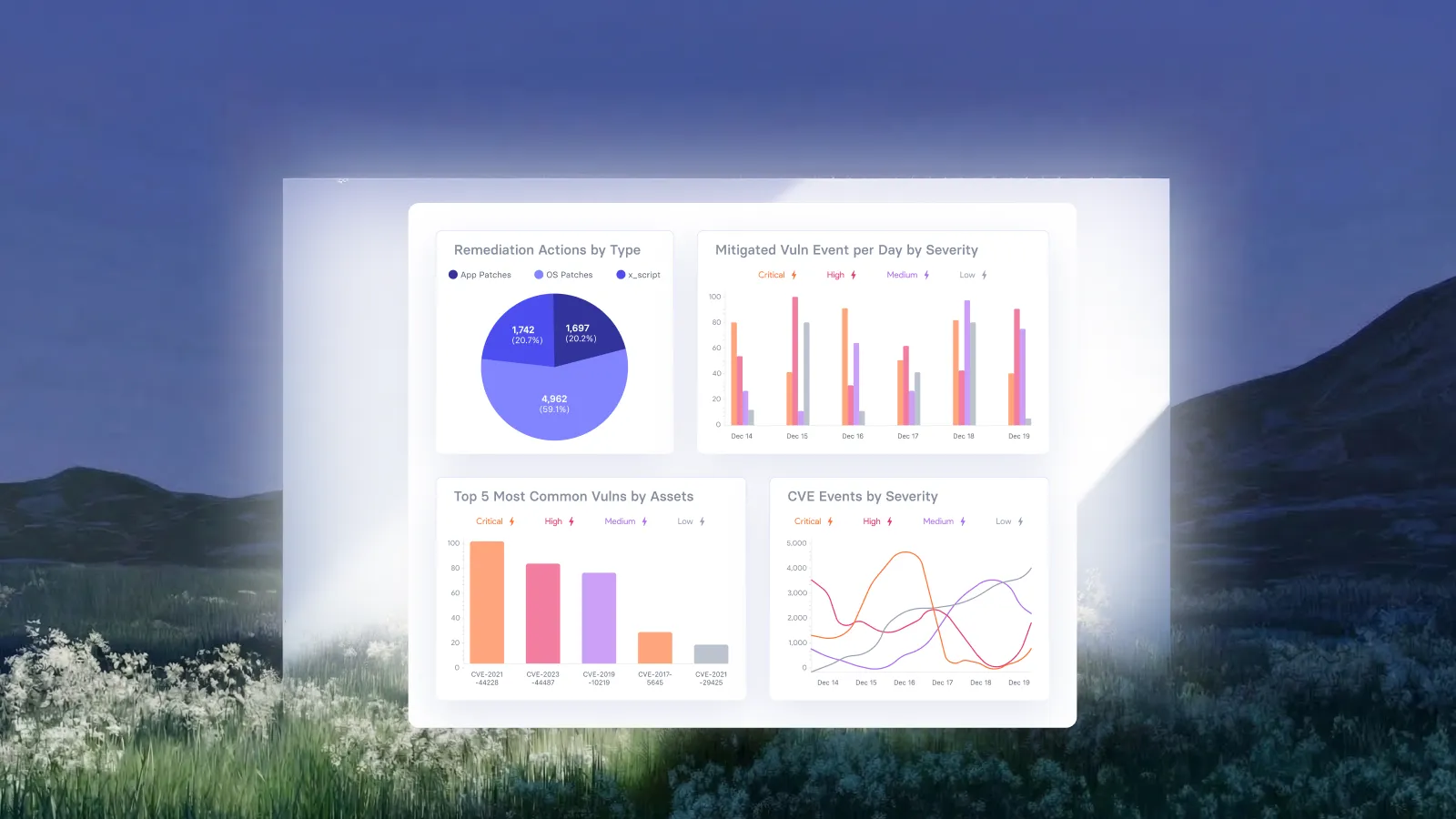
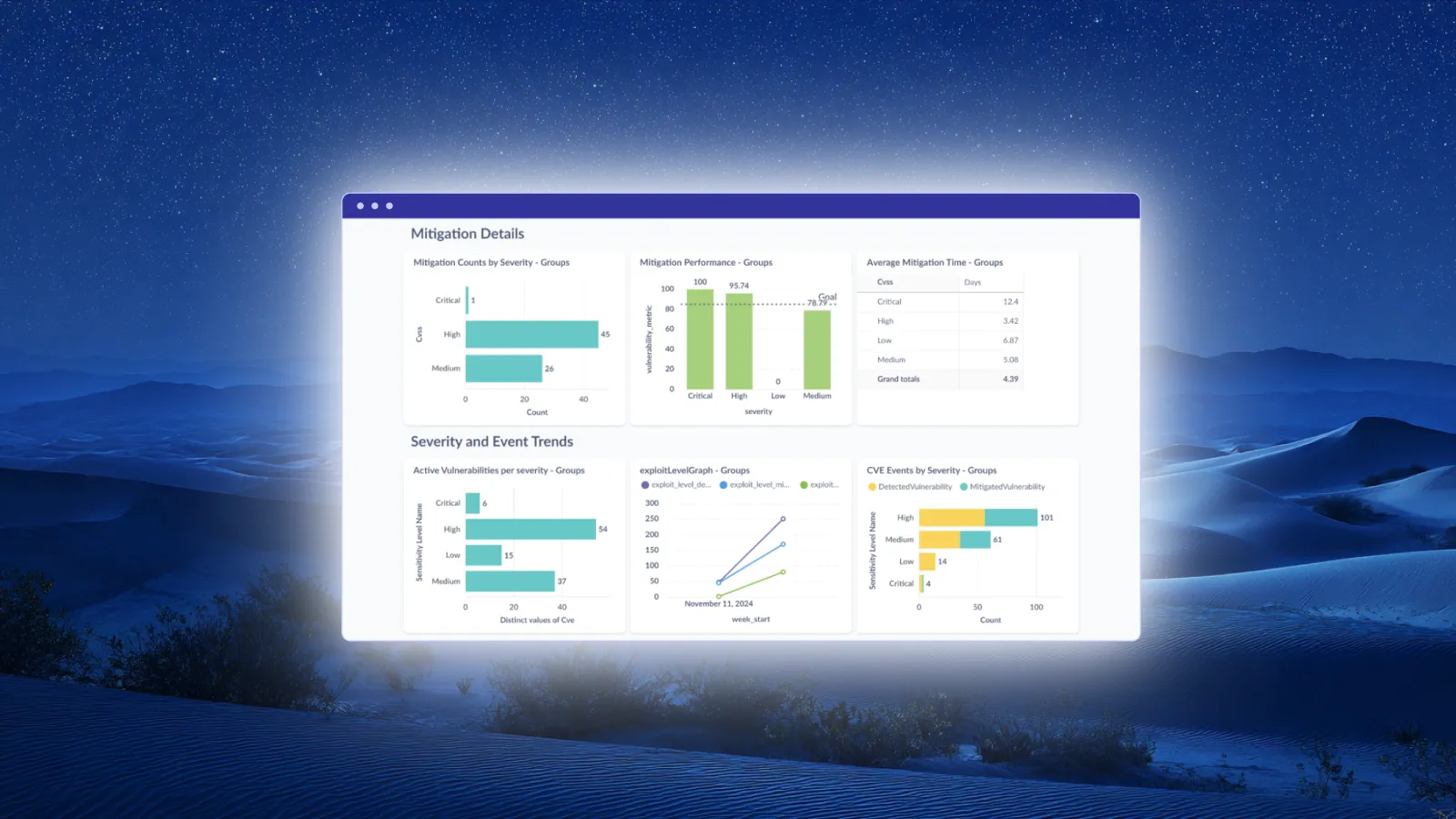
The vRx dashboard provides continuous visibility into the state of each asset: which CVEs are protected patchlessly, which are patched, when each state changed, and what the current risk posture looks like. This is not a shadow system running in the background, it is fully integrated into the remediation workflow.
When to use patchless protection
Patchless protection is not the right answer for every vulnerability. It is the right answer for specific, recurring operational situations.
No patch yet exists
A critical CVE has been disclosed, proof-of-concept exploit code is public, but the vendor has not released a fix. This scenario exploited at or before disclosure is where patchless protection provides its clearest value. You cannot apply a patch that does not exist. You can apply a compensating control immediately.
Patching would disrupt operations
Production database servers, industrial control systems, and mission-critical legacy applications often cannot absorb an unplanned restart. Patching requires a maintenance window that may be weeks away. Patchless protection holds the line until that window opens.
Legacy software with no patch path
Old Java versions, deprecated frameworks, end-of-life applications that the business still depends on these are permanent fixtures in most environments. The vendor no longer ships patches. Patchless protection is the only technical control available short of full replacement.
High-risk assets ahead of a patch window
An internet-facing server running software with a newly disclosed critical CVE carries significantly more risk during the patching delay than an isolated internal workstation with the same CVE. vRx's risk scoring which accounts for asset criticality, internet exposure, and exploitation likelihood can trigger automatic patchless protection deployment for high-priority assets while lower-risk systems wait for the standard patch cycle.
What patchless protection does not do
It is worth being direct about the boundaries.
Patchless protection does not fix the underlying vulnerability. The vulnerable code still exists. If the protection layer were removed, the vulnerability would be exploitable again. This is why the patching workflow remains the goal.
It is most effective for vulnerability classes where the exploitation pattern is well-defined and detectable at the function call level: buffer overflows, use-after-free, injection attacks, privilege escalation via specific system calls. For some vulnerability classes particularly those exploitable through legitimate code paths that are difficult to distinguish from malicious ones the protection is harder to apply without risk of false positives.
vRx applies patchless protection selectively to CVEs where the technical analysis confirms it can be done effectively. Not every CVE in your environment will have a patchless protection available. Those that do represent the highest-value targets, by definition: the vulnerabilities that are most dangerous, most actively exploited, or most difficult to remediate through conventional patching.
Technical requirements
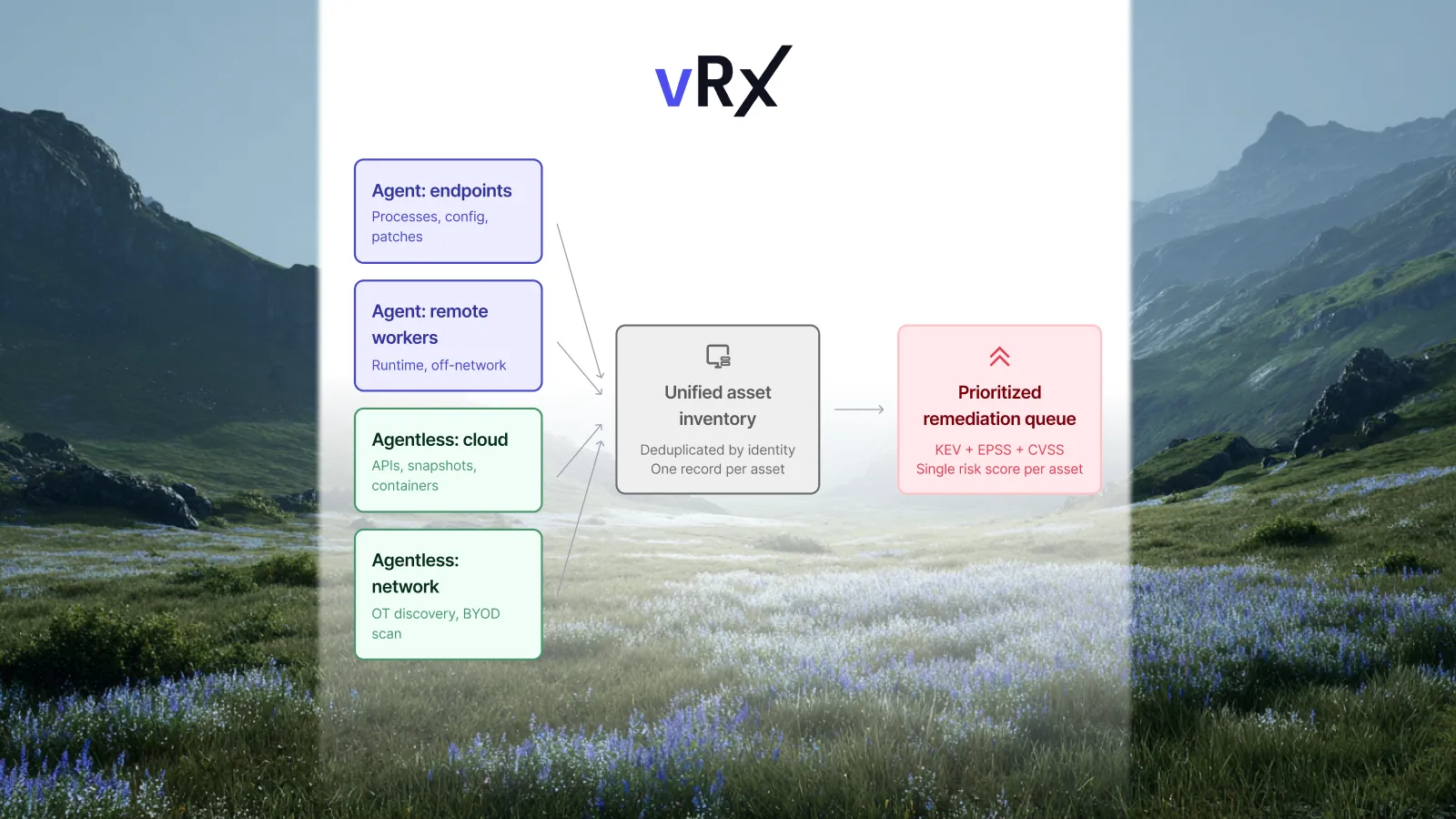
vRx patchless protection runs through the vRx agent, which must be installed on the endpoint. The DBI engine operates in user mode it does not require kernel-level access which reduces the risk of system instability.
The protection is applied and managed from the vRx cloud platform. When a new CVE is assigned a patchless protection, the update is pushed to agents automatically. There is no manual configuration required at the endpoint level once the agent is deployed.
How to activate it
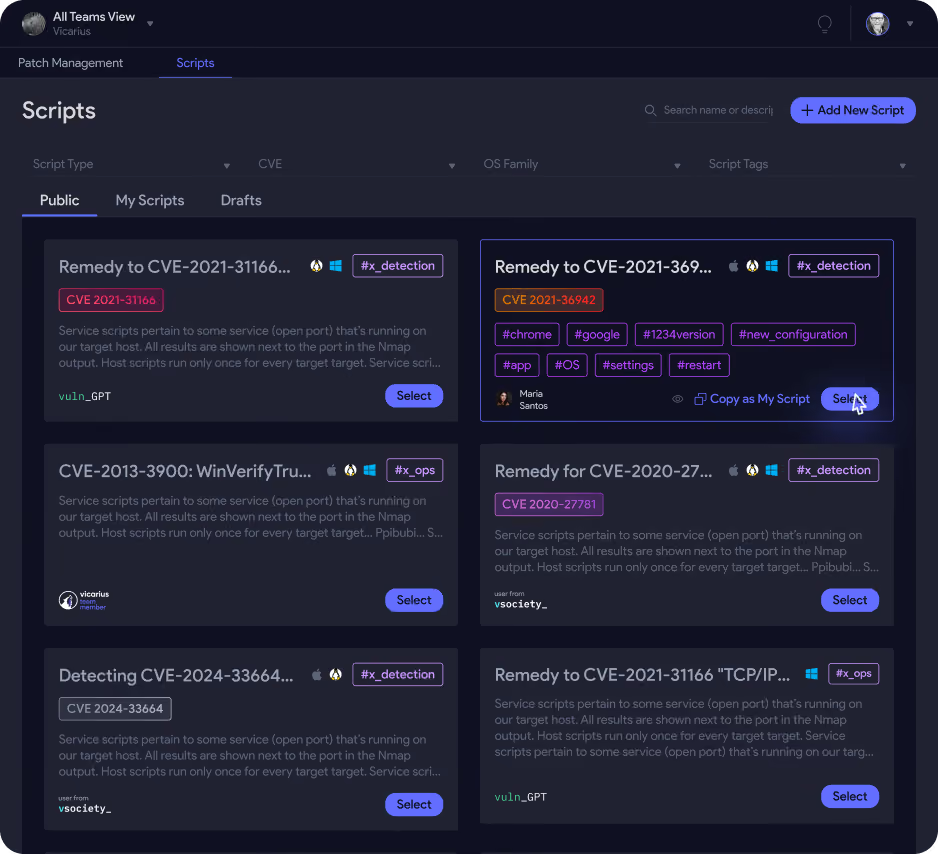
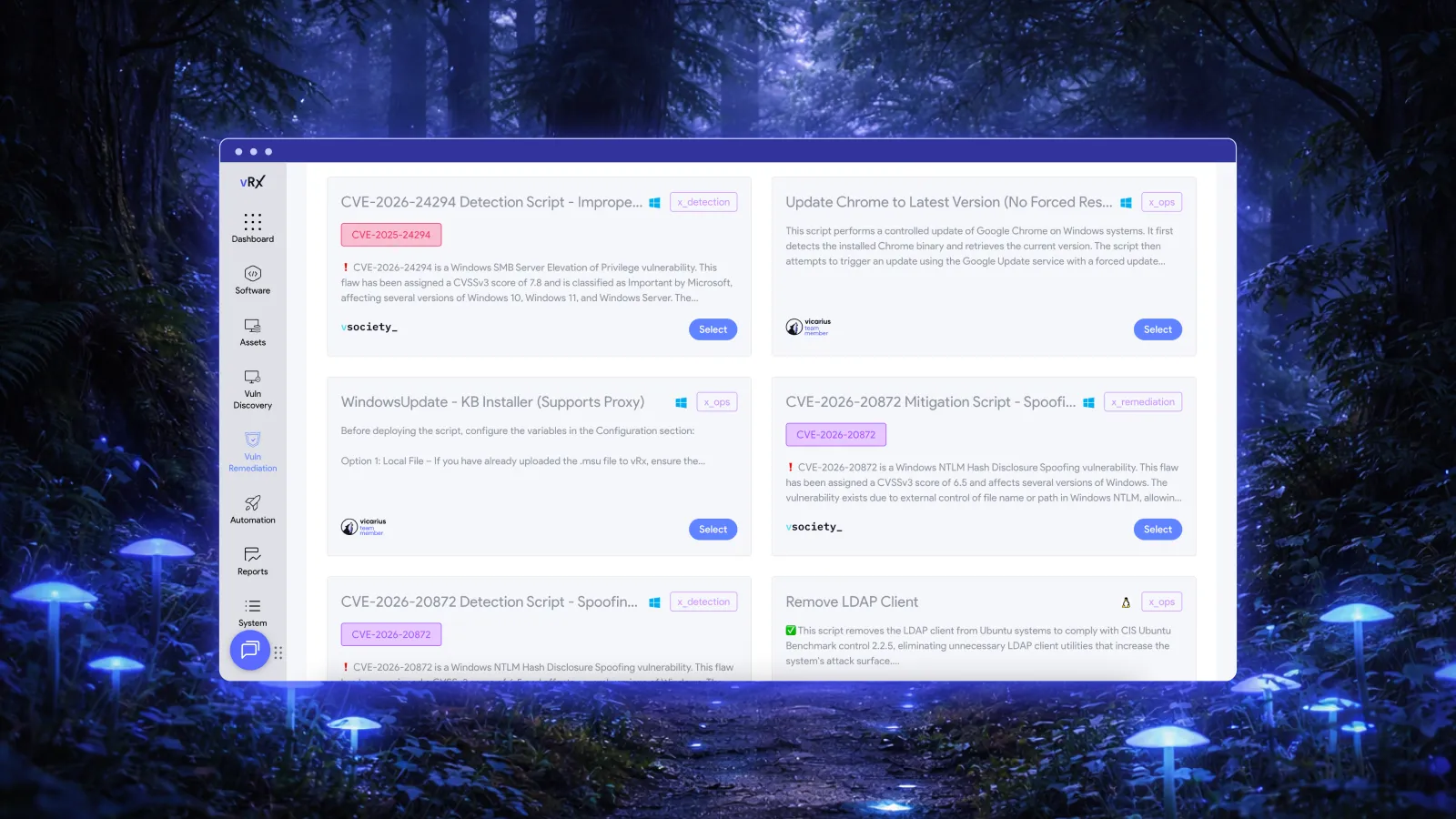
In the vRx platform, patchless protection status is visible per-CVE, per application. Where protection is available for a CVE, it can be enabled in one click.
For organizations running vRx today: Filter your CVE list by "Patchless Protection Available" to see which vulnerabilities in your environment can be covered immediately, independent of patch availability.
For organizations evaluating vRx: Patchless protection is part of the core platform. It is not an add-on. The full list of applications with patchless protection support is available in the vRx apps and OS catalog.
The bottom line
The time between vulnerability disclosure and reliable remediation is shrinking for attackers and not shrinking fast enough for defenders. That asymmetry is structural enterprise environments cannot reasonably patch 131 new CVEs per day, many of which arrive pre-weaponized.
Patchless protection does not change that math. What it does is cover the exposure window with a technically sound compensating control, applied without modifying the application and without requiring a maintenance window.
It works. And it works best when it is integrated into the same platform where you manage patching so the transition from compensating control to permanent fix is automatic, tracked, and auditable.
Frequently asked questions
Does patchless protection require a system restart?
No. Protection is applied to the running process in memory and does not modify the on-disk binary. No restart is required.
What happens if a false positive occurs in block mode?
vRx supports monitor mode, which logs and alerts without blocking. Teams can observe behavior in monitor mode before switching to block mode on critical systems.
Is patchless protection available for all CVEs in vRx?
No. vRx applies it selectively to CVEs where the technical analysis confirms it can be implemented reliably.
Does patchless protection replace patching?
No. It is a compensating control designed to reduce risk during the window between vulnerability disclosure and patch deployment. When a validated patch is deployed through vRx, patchless protection for that CVE is automatically disabled on the patched asset.
What operating systems are supported?
vRx patchless protection supports various application within Windows operating systems through the vRx agent.


































.webp)













%20Signals%20a%20New%20Era%20of%20Supply%20Chain%20Risk.webp)







.webp)